Strange Days & the Millennium Revolution Deferred
Marlowe B reviews Kathryn Bigelow and James Cameron’s millennium epic, Strange Days
Marlowe B
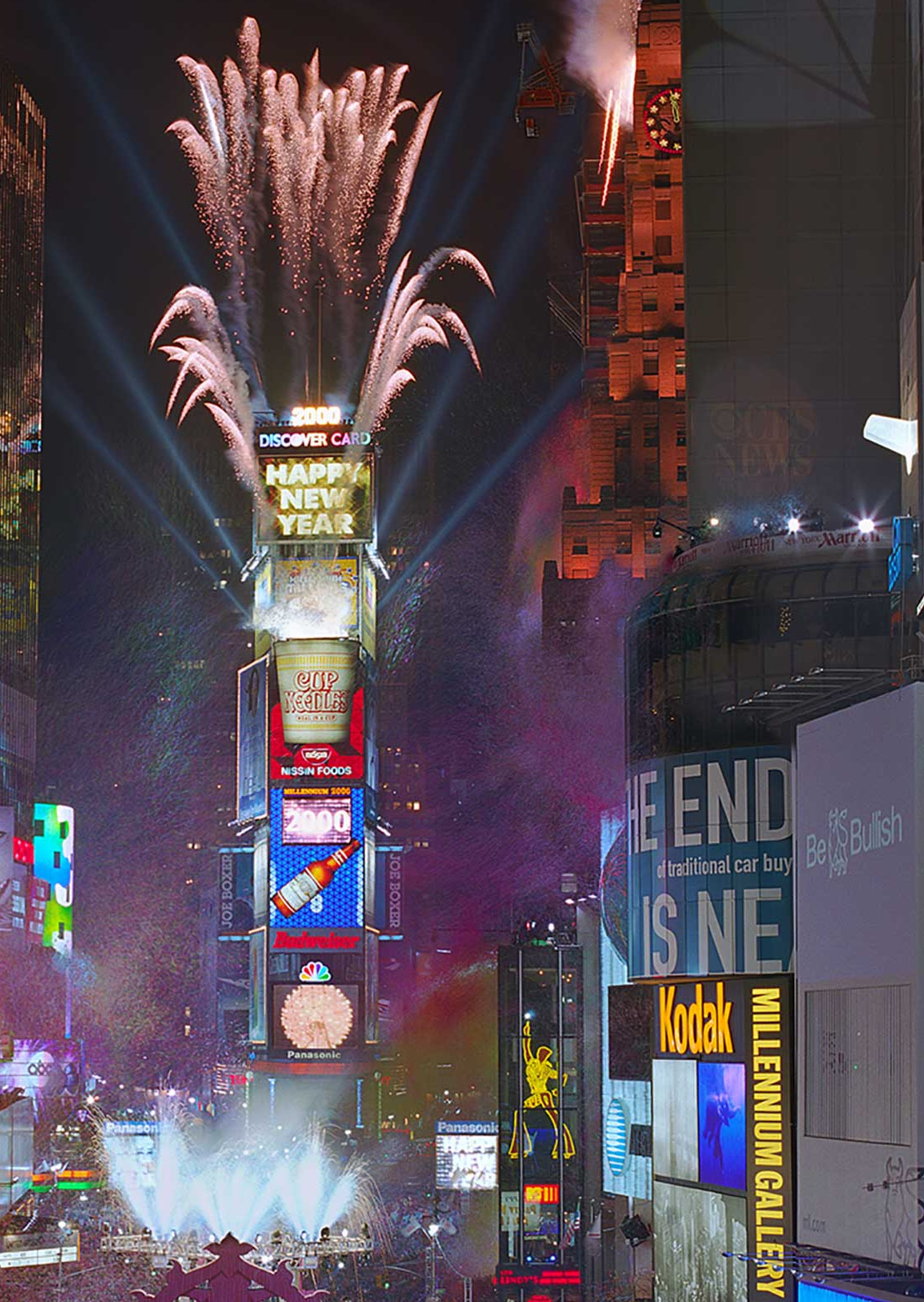
Times Square, January 1st 2000
James Cameron is a strange filmmaker, rarely suspected of being any more radical than the typical “Hollywood liberal,” he nonetheless has a career peppered with hints of something more. He is in fact often thought of as a dedicated company man, someone who made the biggest budget, broadest appealing films of the last three decades. However, Cameron’s liberalism is not a liberalism typical of today, but a more radical echo of liberalism’s past. A liberalism that wasn’t afraid to not only protest the war in Vietnam, but wave the Vietcong flag at protests. A semi-Jacobinism that isn’t afraid to confront the contradictions of its own societal foundations and call for their destruction if that is what is needed for the progress of Virtue. But also a liberalism that hopes that isn’t necessary. Among his canon, one of the more fascinating, and unfortunately little-known films that encapsulates these themes is a film he merely wrote and did not direct. That film is Strange Days.
The Familiar World of Strange Days
Strange Days is a 1995 film that was not successful on release and almost forgotten by mainstream audiences today. It is a science fiction film taking place over the last three days of 1999. It could be described as “cyberpunk” though it may be more appropriate to just call it a near-future science fiction film “that has cyberpunk elements.” In this sense it shares lineage with many traditions. It is a part of a series of films that were made in the 1990s that could be described as “not quite cyberpunk, but clearly inspired.” It is also a part of a series of films made in the 1990s that speculated on the impact of the coming change in millenium. Finally, and most pertinent to this essay, it is a part of a series of films responding to the 1992 Los Angeles Riots and the instigating Rodney King beating.
The Los Angeles depicted is one of hyper militarization. LAPD in full military transports and riot gear line street corners and have checkpoints peppered throughout the city. This isn’t the focus of the film, it’s a persistent background, a fact of life that the characters rarely acknowledge and barely notice. The LA Riots of our world have clearly happened in this one as well and the state’s response has been what amounts to a permanent, seven year long occupation. The world of Strange Days is very much like our own, despite its regular classifications of “science fiction” or “cyberpunk”.
There are no flying cars, laser guns, gene splicing, or many of the other typical trappings of the cyberpunk genre. The one piece of novel technology introduced is what is called a SQUID. The SQUID is basically a video camera which records not just video and sound, but all sensory inputs experienced by the user, with the ability to play them back later. This, we are told, “isn’t like TV only better,” one does not simply see and hear footage but physically feels it, smells it, tastes it, as well. It was developed, we are told, for police surveillance and it is officially restricted from use by the general public.
This does not stop the open proliferation of the technology on the black market. Independent amateur filmmakers rush to create what are called “clips” to be sold via a series of middlemen. These clips consist of what one would initially expect for such a technology, namely a lot of pornography, but also recordings of the execution of crimes such as petty theft. Anything that might bring excitement to the lives of office workers living in late 90’s America. In the opening scene we are shown a clip, being presented to a middleman named Lenny (Ralph Fiennes), an ex-LAPD officer and our protagonist, of a group of individuals sticking up a small, seemingly family owned, chinese restaurant. One might wonder how much payout one could expect from such a robbery, until we realize it wasn’t the money in the cash register they were after at all. Instead, they were after the raw experience to be packaged and resold to some middle class voyeur. This clip ends with the death of the filmmaker and another revelation on this black market libidinal economy: that an increasing number of clips being traded are snuff films. Something Lenny refuses to deal in despite the potential profit incentive.
Three Conspiracies
The inciting incident, predictably enough, is that Lenny comes into possession of a clip he shouldn’t have seen. This clip, recorded from the perspective of an old acquaintance of Lenny’s, a sex worker named Iris, is of two LAPD officers murdering Jeriko One, a prominent black hip hop artist and outspoken political revolutionary. Despite this having taken place two years before his murder, the similarities to Tupac Shakur are striking to a modern watcher. Tupac’s public image meshes well with the presentation of Jeriko One, outspoken, a fixture of Los Angeles culture, not afraid to mix the aesthetics of radical liberatory politics with those of gangster rap. Additionally, in an instance of eerie prescience, it is often speculated that the real Tupac was murdered by corrupt members of the police.
As we eventually learn, this incident spurs three parallel conspiracies with Lenny, and his longtime friend, Lornette “Mace” Mason (Angela Bassett), trying to navigate through the middle. The first conspiracy is the most obvious one, the two police officers who murdered Jeriko One are trying to get the clip and destroy it, and they intend to kill whomever they need to to accomplish that goal. The second conspiracy is more nuanced. Jeriko One’s manager and label owner, industry mogul Philo Grant, is responsible for the creation of the recording in the first place. He had apparently grown a level of paranoia of late, and started spying on his artists convinced they might be planning to leave him. To that end he was the one who used secretly wired sex workers to record Jeriko One on the night of his murder. When Iris eventually returned to Gant and told him of what occurred his paranoia only increased. Over the course of the film he has Iris killed and her copy of the clip destroyed, lest the music world find out about his tendency of spying.
The third conspiracy, in true noir fashion, is a subset of the second, and involves a femme fatale. Faith Justin, Lenny’s ex, a woman he still pines for, left Lenny for Gant before the start of the film. She and Gant have a clearly transactional relationship for her own career advancement as a singer. Gant, in his paranoia, has hired an ex-LAPD officer and apparent “friend” of Lenny’s, private investigator Max Peltier, to spy on her. Unbeknownst to anyone else, the two of them subsequently began an affair of their own. When Gant orders Max to kill Faith, as part of his efforts to tie up loose ends regarding the Jeriko One situation, Max and Faith instead hatch a plan to kill Gant and manipulate Lenny in order to frame him for said murder.
A Radical Rug Pull
Iris, as mentioned, eventually gets an additional copy of the clip to Lenny before being brutally murdered herself by (as we will later learn) Max. Subsequently, Lenny, Mace, and a still apparently friendly (as far as both the main characters, and the audience is aware at this point) Max decide what to do with the clip. Lenny’s chief concern at this point is the wellbeing of Faith, whom he suspects is somehow in danger though he can’t quite figure out why. He initially suggests going to the police, Max warns him against such a plan, as far as he knows this killing could go to the top. He even heard whispers of internal gangs formed within the police force, which acted as hit squads. Mace, most overtly disturbed by the murder of a seminal revolutionary figure of the black community, wishes to go public. Max protests that doing so would kick off an “all out war,” to which Mace responds that “maybe it’s time for a war.”
It is eventually decided that Lenny will use the clip as leverage, trade it to Gant, in exchange for the safety of himself and Faith. Lenny and Mace go to a new year’s celebration Gant’s record label is hosting and Max is working security for. Lenny attempts to find Faith in a skyscraper penthouse while Mace tracks down the chief of the LAPD whom Lenny told her to trust against her better judgment.
The shots of the new year’s celebrations outside are striking, especially for anyone familiar with news coverage of the LA Riots. Sweeping helicopter shots show crowds filling up the streets, as militarized LAPD stand by with their armored transports and riot gear. Although we are witnessing an ostensible celebration, the visual reference is clear as the tension in the story is coming to its climax. In the penthouse, Lenny finds an out of commission Gant. Max and Faith arrive and reveal their relationship and conspiracy to him. Max explains that the tale of systemic corruption he spun was simply to dissuade Lenny from going to the police. That as far as he knew the murderers of Jeriko One were in fact just a couple of bad apples. A fight ensues in which Max, in one of the more unsubtle pieces of visual symbolism shown on film, literally stabs Lenny in the back with a knife. Lenny thereafter manages to force Max over the edge of the balcony who falls to his death in an odd pantomime of Die Hard’s climatic scene.
Meanwhile, Mace makes contact with the police chief and hands him a copy of the clip but is thrown out of the party into the street celebrations where she is spotted by the two cops who shot Jeriko One. Mace finds herself cornered by the police but she manages to fight back and successfully incapacitates them with a taser. Other LAPD officers, seeing a black woman holding two of their comrades at gunpoint, respond as LAPD officers do.
What follows is essentially an abridged reenactment of the Rodney King video. Horrified New Years celebrants look on as multiple police officers proceed to beat Mace with batons, who is on the ground in a fetal position. This only ends when one onlooker, a child, throws himself on one of the cops. This opens the floodgates as the crowds rush the police and soon Max’s promised war seems inevitable. This war is cut short by the arrival of a white savior, the police chief arrives on the scene. He orders his officers to release Mace, and shows the two corrupt cops the copy of the clip he apparently watched, and places them under arrest. The two police officers do not take this well. One of the arrested cops immediately shoots himself. His now blood-covered and traumatized partner snaps and begins to pull out his gun to shoot Mace, before being quickly gunned down by his coworkers, who only moments before were enthusiastically beating his victim.
Thereafter, the film ends, the countdown reaches zero, it’s the year 2000, Faith, the ghost of Lenny’s past, is finally exorcised as Lenny and Mace kiss and Faith is placed in the back of a police car. Likewise the racial tensions haunting Los Angeles similarly dissipate as the crowd celebrates the new millenium.
Cameron vs. Cameron
Strange Days is a movie about moving forward while dealing with one’s past. The LA Riots hang on like a counter-thesis to Fukuyama, a Derridian haunting as we look to the future millennium. Lenny pines for a woman who stopped loving him long ago, as the woman who loves him now selflessly works to save him. If history is to end, this film suggests it won’t go quietly. Ultimately, however, it does go eventually. Lenny gets over his ex, and the LAPD leadership ultimately does the right thing by its citizens and purges its bad apples. One could even imagine that when January 1st starts, the checkpoints and militarized police might finally pack up and leave. It would be tempting to dismiss this film as nothing more than liberal ideology, how much more revolutionary is it really than say Demolition Man? It acknowledges the existence of bad cops but it makes it clear it’s not systemic, and working in the system ultimately becomes the best way to clean them out. It is as if this film contains two voices, two James Camerons.
The first voice is the voice of the radical James Cameron, a voice so in tune to the zeitgeist of 1995 he seemingly predicted the most impactful celebrity death of the 1990s two years before it happened. He built a world and story designed to support the thesis that the Civil Rights Movement of the 1960s is unfinished, the issues have not been solved even as we enter the cusp of a new millennium. Moreover, the solution to these problems might, in fact, have to be violent, and those who are victimized by state violence in fact have every right to see popular violence as a legitimate avenue for their deliverance. The LA Riots of three years prior, traumatically burned into the minds of white America like a latter day Nat Turner were not only to be expected, but perhaps desirable if they might once and for all cleanse the ghosts of our past and purify us so we can enter the future.
It should be noted as well, the critiques of the police, even those later revealed to be false within the logic of the film, were fairly extreme for a mainstream film of the 1990s. Even if the description of deputy gangs was later explained away as a red herring, they actually were and likely still are real. Even if we handwave the killing of Jeriko One as the result of bad apples, the police who pulled the trigger made it clear that his radical anti-racism, anti-police sentiments, and specifically working class community organizing was the primary reason for the killing. Although their actions may have been superficially their own, their motivations arose squarely from within the system and serve those interests.
Finally, the setting of the militarized Los Angeles is one of the most striking displays of Cesaire’s imperial boomerang on screen. Checkpoints dot the street like it’s occupied territory. It recalls in many ways Mark Fisher’s observations of Children of Men, the matter of factness of every day totalitarianism mixed with ostensible liberal democracy. One could imagine franchise coffee shops existing alongside internment camps. It is the undertone, the believability and familiarity of state repression that makes the climate of the film all the more impactful. The audience, an audience which paid to see a James Cameron movie in 1995, has been truly primed to cheer for a replay of the LA Riots on the side of the rioters. The child who launches himself at the cop who is beating Mace is clearly heroic. The men and women who follow him come down like Gandalf’s relief army at Helm’s Deep. These aren't the alien streets of V for Vendetta’s fantastically dystopian London, these are our streets, we walk them everyday. The cops aren’t faceless thugs wearing armbands with the novel logo of some imagined fascist government, they are the cops we see everyday. The people who choose, in a moment, to enact violence against the police aren’t a bunch of Guy Fawkes mask wearers fighting for some vague notion of “freedom,” they are us, their struggle is ours. We can imagine ourselves in the shoes of those who might be driven to riot, in fact we would hope to share their courage.
The second voice is James Cameron, the company man. One could be tempted to ascribe this voice entirely to some hypothetical studio meddling, or perhaps Cameron practiced self-censorship in anticipation of the same. Ultimately, it doesn’t matter. He explains, in exacting detail, how the LAPD uses its veil of secrecy and violence to enforce a shadow government on the citizens of the city only to declare that a lie. He primes the audience to call for the violent overthrow of the system only to show how justice can be accomplished by the better angels of that system. The very nature of the ending plays like a liberal wishcasting of how the Rodney King fallout should have happened. A video is taken which shows the truth, it is handed to proper authorities, and those in charge don’t ignore it but do the right thing, thus averting disaster. Even the police officers beating Mace in what is clearly a play-act of Rodney King are shown to simply be mistaken, and equally willing to serve actual justice when the truth is revealed to them.
It is hard to pin down what we are meant to conclude from Strange Days. Which of these Camerons is the real one, who is telling us the truth? The Marxist in us might be tempted to synthesize its contradictions. In the words of Zizek, let us take the third option. It isn’t an option that magically transforms Strange Days into an unassailable piece of revolutionary theory and art, but it also isn’t reactionary. The film is aware that the ghosts of America’s past have not been truly exorcised, but it is perhaps naively hopeful that America is good enough to take that burden on. In either case, it knows that this is not a problem that can be ignored, even if it suggests it might be solved peacefully from within. The coming new millennium is a reckoning. It is a countdown for America. One way or the other, by peace or violence, inside the system or out, we will confront our past, and there will be a new beginning after. If nothing else, that message certainly rings true today.