



Years ago, I recognized my kinship with all living beings, and I made up my mind that I was not one bit better than the meanest on earth. I said then, and I say now, that while there is a lower class, I am in it, and while there is a criminal element I am of it, and while there is a soul in prison, I am not free.
— Eugene V. Debs, September 18, 1918.
“Woke 1” was not crazy.[1] Abolition is not a mistaken rhetorical overreach of the unsophisticated masses that began in 2020. It is the organic, righteous demand from millions of people to the relentless terrorism inflicted by the imperial police state.
If DSA intends to be a vehicle for Black liberation, where Black and other colonized peoples can participate fully, we cannot treat abolition as a hyperbole to distance ourselves from. Marxist Unity Group sees the abolitionist movement—from the general strike of the enslaved, through the prison rebellions of the 60s and 70s, to the Ferguson and George Floyd uprisings—as a primary struggle against the white supremacist capitalist system. Abolitionist demands were fundamental to socialist politics in the Paris Commune of 1871, when working-class Parisians seized control of the city, abolished the standing army and replaced it with a civic guard with internal democracy and direct accountability to the working class, recognizing these carceral systems as the ‘unfailing weapon’ of the bourgeoisie. From Vladimir Lenin to George Jackson, the socialist position on police and carceral power has always been and must always be rooted in abolition.
Abolition needs to be explained through the minimum program demand: the working class cannot rule while a large part of it remains policed, caged, and chained.
As Marxists in DSA, we fight for the revolutionary horizon of democracy and socialism, agitating for and popularizing the minimum program that we will implement immediately upon workers taking power. That horizon is impossible without the abolition of the carceral state. A minimum socialist program cannot and will not be shaped by chasing popular opinion polls; instead, the working class must carry out the minimum program to transform the political and economic structure of our state, from one based on slavery and exploitation to a worker’s republic advancing a fully liberated, classless society. There are many demands critical to the minimum program: like democratic reforms and universal housing, healthcare and food for all. Yet these demands are incomplete without the abolition of the capitalist carceral state, in the form of jails, police, prisons, and surveillance structures designed to protect private property, maintain ruling class power, and imprison those of us fighting for a free and beautiful world.
Who dragged students away as they studied in encampments and demanded a Free Palestine? Who shoots and kills environmental organizers and Indigenous people from Standing Rock to Cop City? Who enforces evictions, then throws away the intimate belongings of our neighbors forced out of their homes and into sleeping between the cracks beneath bridges? As socialists, we must commit to abolishing the instruments of exploitation as well as the instruments of enforcement.
Our comrades touting reactionary anti-abolitionist talking points misunderstand both the world we live in and the world we are fighting for. We refuse to be distracted or allow our demands to be limited by the hegemonic discourse of our enemies. As Critical Resistance explains, “Abolition is both a practical organizing tool and a long-term goal.”
Because abolition is more than a transitional demand, we have a duty to organize the working class to win the democratic mandate for this program holistically. If the working-class masses aren’t yet on our side to demand our minimum program, then we are not in the revolutionary situation required to institute it. The wins we celebrate most today, such as the abolition of chattel slavery, were once rejected and repressed by those in power, and many were even unpopular among the masses. But the fight for freedom is not a popularity contest, and we owe the power of our demands to all those who stayed the course despite their lack of popularity.
The State of the Crisis
The carceral state is politically, ideologically, and morally indefensible. We live in a country that has a massively oversized police and prison population for a reason: to politically dominate and disempower millions of people in order to reproduce white supremacist ruling-class order and a political constituency economically bound to the carceral state. This system did not drop out of the sky; it was designed to crush the liberation struggles of Black people, and it has been hideously successful. The most “unserious” idea is believing we can achieve socialism and democracy while millions remain in chains.
Until we have a new set of rules that structure our society through a democratic constitution, we will continue to suffer in the hellscape slaveowners and capitalists architected for their benefit. As Derecka Purnell explains in her book Becoming Abolitionists, “The people who chose the police were the same people who drafted the Constitution, who started the wars, who owned slaves, who possessed property, who had the most to lose if oppressed people ever decided to revolt: wealthy white men.”
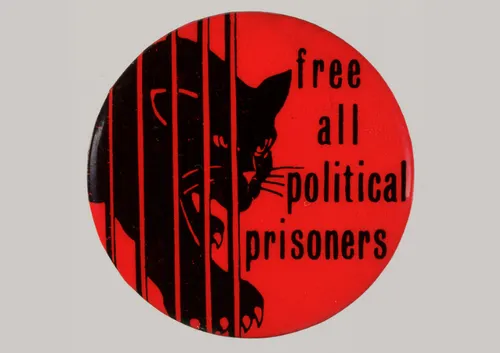
The struggle of generations before us and the lived experience of our comrades has led to an embrace of the abolition of policing and prisons as a whole. The scope of the social crisis and obvious demand is clarified in DSA’s Workers Deserve More program’s call for fully abolishing the police and prison system which protects the rich and jails the poor.
Abolition is a Minimum Program Demand
From Fox News to AOC to DSA-Cadre Mayor Mamdani to some rank-and-file members, people have characterized the demand to abolish police or prisons as “implausible,” “even for the long term.” But the issue with the Left’s typical “abolitionist” rhetoric has nothing to do with its unpopularity and everything to do with its presentation as a vague agitational slogan rather than an integral component of a revolutionary minimum program to transform our society. This has much in common with the Trotskyist concept of a “transitional demand:” a revolutionary reform that socialists should rally the masses behind today (a non-revolutionary moment), which, while popular or intuitive, is in actuality only achievable under a revolutionary situation. Simply put, a transitional program is a list of revolutionary slogans, with the people fighting for them expected to realize in time that in order to win the demands, a revolution needs to happen.
‘Abolition’ has been treated largely as a rhetorical critique of our policing system, where the end-demand goes somewhere between the complete abolition of all systems of carceral control and the level of policing present in white suburbs (which is a part of the same system that overpolices Black and brown neighborhoods). This lack of clarity as to how abolition can be achieved made sense in the context of a quickly evolving mass political movement, but rather than learning from and being in struggle with working-class abolitionists toward the development of a revolution, it has prompted the degeneration of “abolitionism” into a vibe, a vaguely held political brand.
Instead of a transitional program, Marxist Unity Group fights for the traditional Marxist minimum-maximum program, which lays out the minimum demands necessary for the working class to effectively govern ourselves and achieve the maximum program of communism: a stateless, classless society free of exploitation and oppression. This paradigm points us to demands that may seem more radical and extreme than some transitional demands, because the minimum-maximum program asks us not what’s popular, but what must be undertaken to dismantle the load bearing aspects of capitalist institutions that causes human and planetary suffering and replace them with a state controlled by the working class. For our minimum program, we believe DSA can afford to be more specific about what we mean when the working class institutes abolition of the carceral state. Our representatives, tribunes, and organizers should be equipped with the political education and loyalty to our program to name simply that we are committed to ending the carceral state and making sure we are addressing the root causes of violence instead of causing more violence.
It is also clear that this programmatic confusion arises in part from a lack of a positive vision for how exactly we are supposed to carry out abolition. That is to say: the police will not abolish themselves, any more than chattel slavery abolished itself during the Civil War. Then, it took the organization and arming of formerly enslaved Black people together with conscious political agitation to carry out abolition in this country. And it will take more than that to finish Reconstruction today.
That is why we in Marxist Unity Group recognize that the road to abolition requires the abolition of the separate class of police as well as the separate class of the imprisoned. This requires the creation of a democratic and popular militia—flowing from the working class and the oppressed’s organs of self-defense established under capitalism and defined by the right to bear arms, the sovereignty of the people, universal service and training, and a rigorous community control coexisting with the democratic rights of members. Further, Marxist Unity Group calls for the extension of labor and legal rights to the imprisoned.
A party that asks us to leave the demand for abolition back in 2020 is not a party serious about the liberation of Black, colonized, and working-class people. Any “socialism” that abandons this demand will have abandoned the working class whose liberation it’s meant to secure. So we remain steadfastly committed to an abolitionist future and will fight like hell for the working-class majority we need to implement our minimum program. Abolition of the carceral state is inseparable from the demand for a democratic socialist republic. As Assata Shakur and Karl Marx taught us “we have nothing to lose but our chains.”
Here we reject the racist, derisive recent use of the “Woke 1” to demean the rallying cries of the George Floyd and Breonna Taylor uprisings deployed by people like Alexandria Ocasio-Cortez as explained throughout this piece. We further reject the general use of the term “woke” by conservatives, liberals, and so-called socialists alike, whose objective impact is to spread a mocking historical amnesia underpinned by a fear of the reality that Black liberation demands a revolution. The Black liberation struggle will continue to swell and erupt in this country until it is secured, and those demanding abolition of all structures that keep oppressed people in chains are the most clear-eyed of us all. ↩︎