In Defense of Principles
Gant R analyzes the split and collapse of the Socialist Party of America in light of today’s debates in DSA. Political principles, rather than metrics of moral purity, are the only means to build unity in opposition movements.
Gant R
Political divisions in the socialist movement are nothing new, but our understanding of them changes over time. Many Democratic Socialists of America (DSA) members remember Representative Jamaal Bowman’s 2021 vote for Iron Dome funding as the first time the unity of our political project was seriously called into question. For the last 4 years the fight for Anti-Zionist electoral standards has drawn out fierce conflict between the different tendencies of our organization, from the National Political Committee’s decision to set conditions on AOC’s re-endorsement in 2024, to the hard-won victory of Resolution 22 at DSA’s 2025 National Convention.
The DSA right has increasingly framed the debate as a conflict between an inward-facing “sectarian wing,” defined by morality policing and purity tests, and an outward facing “mass politics wing,” defined by hard-nosed, practical politics that recognizes the messy compromises needed to build a mass base. NYC-DSA’s right-led chapter leadership has proposed that the mere idea that elected officials should be held accountable to their party has only emerged “in moments of decline and marginality” for the Left.
When we have major factions calling consistent politics a sign of marginal sectarianism, it’s clear that we have work to do to rescue some of the most basic principles of party-building from historical obscurity. This applies equally to the so-called “principled” politics of the left-wing sects and social media influencers, which make moral proclamations atomized from mass organization and detached from political practice. Principles, especially as they apply to electoral politics, are not a metric of moral purity, but a necessary part of how political organizations function.
Bourgeois parties rely on a complex system of political patronage, pre-existing access to the levers of state power, corporate funding, and especially in the United States, a monopoly on deciding the rules of the game in an undemocratic electoral system. The Democratic Party can afford to break from its base on Palestine, on healthcare, on trans rights, and on abortion. It will certainly suffer electorally for this backsliding, but since its organization relies on funding from wealthy donors instead of the labor of a mass volunteer base, it will not collapse.
Parties like ours rely on none of these. We are measured only by the strength of our organization, the trust and zeal of our rank-and-file, and the convincing power of our ideas. For democratic mass parties, excluded from political power, principles are what cohere our political project. Far from a product of the Left in decline, a commitment to unity around a common program defined the peak of our movement in the early 20th century, and the retreat from this principle had devastating and long-lasting consequences.
Twin Histories
The United States once had a Socialist Party, much like our own, which united all the trends of our diverse movement into a single political force. Its power and influence, while small relative to the whole country, would strike us as something alien today. It elected 2 Congressmen and thousands of state and local politicians on an independent ballot line. It marshalled up to 6% of the presidential vote for perennial candidate Eugene Debs, and it could rally tens of thousands, not just in New York City, but in the far-flung agrarian districts of Oklahoma.
And its political debates, too, were much like our own. Left to right, a strategy of intransigent political opposition was counterposed to an emphasis on passing constructive political legislation alongside liberal allies. Many of these debates centered on the role of elected office. Should the Party “truck votes” to win at all costs, or should its representatives aspire to more, to educate and organize the class around a struggle for socialism and democracy?
Upon the outbreak of World War I in August 1914, socialist parliamentarians across Europe voted for war credits, and by doing so endorsed their governments’ prosecution of the war. The international socialist movement split down the middle, and American socialists met these events with confusion and dismay. How could the great socialist parties of Europe, with all their size and prestige, support sending the working class of each country into the fratricidal mincing machine of war?
At first, the SPA was united in its response. The party would not repeat the failures of its sibling parties in the Second International. When the U.S. formally entered the conflict in April 1917, the SPA called an Emergency National Convention in St. Louis. They ratified a proclamation which railed against militarism on all sides:
As against the false doctrine of national patriotism we uphold the ideal of international working-class solidarity. In support of capitalism we will not willingly give a single life or a single dollar; in support of the struggle of the workers for freedom we pledge our all.
But even before U.S. entry into the war, there were exceptions to this unity. A number of party members, including New York Congressman Meyer London, argued that socialists would be justified in supporting a war of “national defense”—the same argument given by French and German socialist deputies to vote for war credits. A section of the movement even argued that socialists were duty-bound to support their country during wartime. But this pro-war minority was vanishingly small. A group of prominent intellectuals split off from the party, but the overwhelming majority of both Party leadership and membership upheld its anti-war program, affirmed by the St. Louis proclamation.
As the pressures of wartime politics grew, however, so too did pro-war sentiment. Though the pro-war minority remained small throughout the war, it increasingly held sway among a significant section of the Party’s most powerful members—its elected officials.
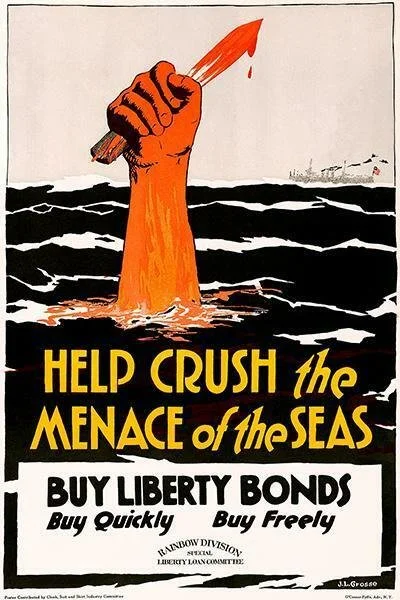
In April 1918, the SPA’s seven representatives on the New York City Board of Alderman (the predecessor to the City Council), voted in favor of endorsing a municipal “Liberty Bond” campaign to fund the war effort. The party membership immediately erupted in outrage. Algernon Lee, the chair of the socialist group on the Board, gave the motivating speech. The threat of German militarism had pushed broad sections of progressive society to support the war. Socialist electeds represented more than just their Party, he argued, they represented the broader liberal movement which elected them.
The issue divided the socialist Alderman group, which was bound to vote together as a bloc. Abraham Beckerman, one of the dissenters in the delegation, stayed away from the meeting to avoid splitting the vote. But he and his colleagues, he argued, had no right to go against the Party’s anti-war program. Beckerman took his case to his party branch in the 6th Assembly District, and asked members to weigh in on the group’s actions. The branch overwhelmingly endorsed Beckerman and condemned the socialist vote for Liberty Bonds. In the coming weeks, party branches across the city held meetings to discuss the issue. By the end of April, the balance sheet was clear—27 branches denounced the actions of the socialists on the Board, 3 endorsed, and 4 even called for resignation or expulsion.
Local party leadership, sensing the tenor of the moment, stewarded the opportunity for membership to weigh in on the issue and hold their electeds to account. And the Aldermen, to their credit, were generally willing to be held accountable—spurred on both by the membership and by dissenting members of the delegation.
But as Spring turned to Summer, the atmosphere changed. Socialists bitterly fought over the re-endorsement of New York Congressman Meyer London, who supported the war despite his own moral misgivings. This led to a narrow vote—first against endorsement, and then after a re-vote was called, a narrow vote in favor. Many of those who supported London’s endorsement detested his position on the war, but recognized his immense popularity and believed that no other candidate could beat Tammany Hall in the Lower East Side. On the other side, opposition to London became even more raucous as Party members called for his expulsion.
The lose-lose nature of the debate over London set the tone for Fall 1918, when the Aldermen were again faced with difficult votes. Without time to deliberate amongst themselves, they voted in favor of a snap proposal on a new Liberty Loan drive, and for appropriations for a massive “Victory Arch” to adorn 5th Avenue during a military parade for returning soldiers. The Aldermen later regretted both of these votes, which partially occurred under duress in a political atmosphere defined by the repressive censorship regime of the Espionage and Sedition Acts. But the damage had been done.
This time, there would be no democratic account. Between Spring and Fall, something had broken. Trust had been lost. The left and right, no longer united around upholding the party program, bitterly feuded over how to deal with the elected officials. The leadership of Local New York, dominated by the party right’s political machine, now acted to defend the electeds from member criticism instead of stewarding a process of accountability. The party left, for their part, became increasingly intransigent in their demands—for the expulsion of London, for recall of the Aldermen from the Board, and for removing all reform planks from the Party platform. Both sides negatively polarized against one another, locked in a political death spiral.
These conflicts were now defined by disputes over party democracy. The right used its control over the party machinery to steer meetings in their direction. They chaired meetings one-sidedly, Central Committee delegates stopped reporting back from the branches during role-call attendance, and a proposal to unify the Locals of Greater New York, including the Brooklyn and Queens Locals dominated by the party left, fell apart. During these months we see the first signs of utterly chaotic breakdown in the party branches—conflicting reports of fraud, mutual recrimination, and multiple parties claiming to be the legitimately elected leadership.
The dam broke in early January 1919, at a city-wide meeting called to discuss the Aldermen’s controversial votes (Draper, 145, 422). Alderman Lee gave a lengthy speech which avoided the subject entirely. The chair opened for questions, which the other Aldermen leisurely answered. As minutes turned into hours, motions from the floor were repeatedly ignored by the chair. As soon as it became clear that the meeting was a sham, half of the delegates bolted the meeting, including the entire delegations of Locals Queens and Brooklyn. In an adjacent room, the delegates elected the leadership of what would become the “Left Wing Section” of the Socialist Party of Greater New York.
What happened next is well-trodden in any general history of the SPA. The left-wingers launched a bid to win control of the Party, and the “party regulars” moved to stop them at any cost. Locals and branches entered a state of civil war, with New York at its epicenter. In April, the New York state organization voted to expel any local that affiliated with the Left Wing Section. The lefts appeared to be on the verge of victory when they ran away with the National Executive Committee elections in May. But both sides were committed to either rule the party or ruin it. The right called fraud, and they moved quickly and without remorse.
By the time the dust settled, the right-dominated National Executive Committee had purged tens of thousands of members, including the entire state organizations of Michigan and Massachusetts. The Left-wing fractured amongst itself on whether to immediately form a new party or stay in the SPA to fight it out. The parties consummated the split at an Emergency National Convention in September. Two rival Conventions established the Communist Party and the Communist Labor Party. One party had become three—but the size and influence of the socialist movement decreased by an order of magnitude. 100 years later, our movement is still recovering from this collapse.
The role played by the October Revolution in galvanizing left-wing opposition in all the old socialist parties is undeniable. But academic historians like James Weinstein are wrong to treat these events like a bolt out of the blue for an otherwise well-functioning party. Or, like Daniel Bell, as the inevitable conclusion of socialist politics, detached from the (pro-war) reality of American political life. The source of the split and collapse of the SPA cannot be located in simple fractiousness and internal strife—which had dominated the party through its entire existence, even times of growth. The split materialized around concrete organizing issues, flowing from the relationship between party democracy and elected officials who violated the SPA’s anti-war program.
Lessons for Today
This story should send a shiver down the spine of any organized socialist. Today, DSA’s party project is much less developed than the Party of Debs. Our roots in the working class are shallow, our debates often immature. Our historical memory of the great movements of the past is broken. And yet, this is the best shot we have for building an enduring mass socialist movement in the United States.
These historical actors were not heroes or villains. They were like us—doing what they thought was best under difficult circumstances, making disastrous mistakes in the process. What this history teaches us is that there is no simple binary between “inward-facing” and “outward-facing” politics. Compromises have consequences, and unity is hard won and easily lost. The party’s program and structure defines its intervention in the workers movement. We decide amongst ourselves the politics we practice out in the world.
Principles are not abstract moral purity tests, as the DSA right of today claims. They are those shared commitments and ambitions that bind us together in a common organization, even through the most trying internal division. They are not guarantees of virtue, but the material preconditions of collective organization which relies on the voluntary activity of the rank-and-file. Concrete questions around program, discipline, and accountability are decisive for the health of our organization, the commitment of our members, and ultimately, the ability to achieve our goals.
When NYC-DSA’s co-chair tells the New York Times that “we don’t have any red lines,” they are not only saying something dangerous, but spreading a falsehood. If AOC came out tomorrow in support of conversion therapy and climate denialism, members across our chapter’s political spectrum would clamor to unendorse her. The right clearly has standards, or they would be organizing in the Democratic Party and not DSA. What they advocate for, instead, is negotiating those standards behind closed doors and out of the view of the membership. With any notion of member-led politics safely out of sight, our only visible political program is what our elected officials say and do. This is obviously untenable. Another crisis has and will arise, especially as one of our own gears up to govern the largest city in the country.
The decision by socialist elected officials to vote for war credits, and by a significant portion of the movement to follow them off the cliff, wrecked the socialist movement for over a century. This produced more decline and marginality than any dissent ever could. There is no easy or pragmatic path to victory. The project to permanently insulate our electeds from party democracy is not, in the end, a path to “mass politics” over inward-facing sectarianism. It can only lead to ruin, and the shipwreck of 20th century socialism is a testament to that fact.