Toward a New American Founding
Luke P reviews Osita Nwanevu’s The Right of the People: Democracy and the Case for a New American Founding
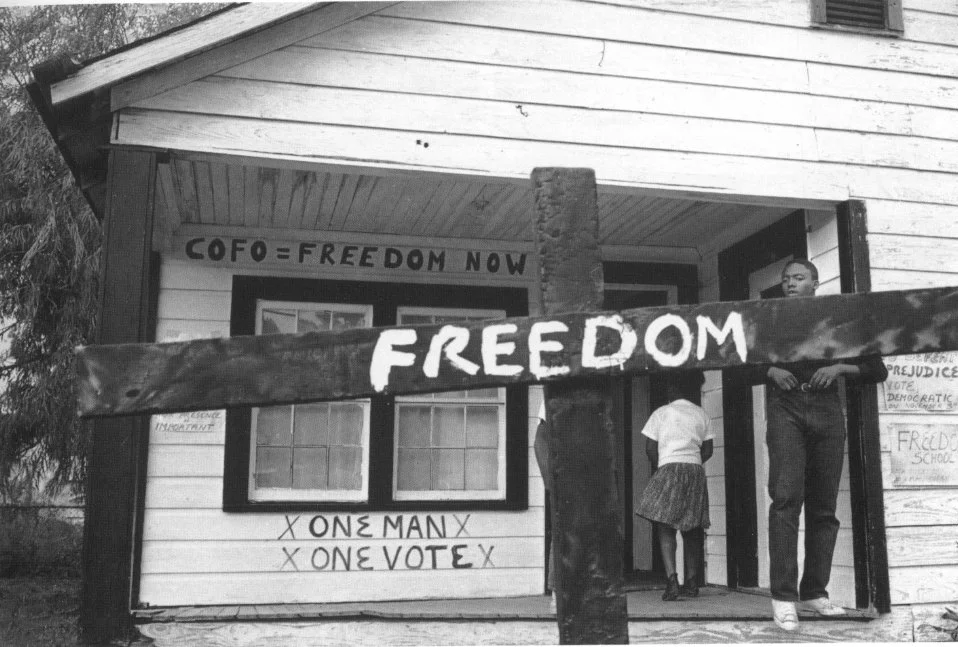
Tamio Wakayama, photo taken during the Freedom Summer of 1964
Some childhood memories last longer than others. For Osita Nwanevu, it was a day in early December 2000, when, surrounded by upset adults, “it was imparted to me that George Bush had lost the popular vote… but was going to be president anyway.” Bush’s victory after the Supreme Court stopped Florida’s recount was “basically unfair… in a way that has stuck with me all of these years.”
That early impression of unfairness deepened over time. In 2016, Nwanevu saw another president enter the White House despite losing the popular vote, and later watched as just 43,000 swing-state votes prevented a repeat in 2020. During the Biden administration, Nwanevu grew tired of explaining why crucial bills like Medicare for All, the Green New Deal, or Build Back Better were dead on arrival in Congress, even when Democrats won. And then Trump returned for a second term.
These experiences drove Nwanevu— now a columnist at The Guardian and contributing editor at The New Republic — to write his new book, The Right of the People: Democracy and the Case for a New American Founding. The title invokes the Declaration of Independence and Thomas Paine’s memorable assertion that “every age and generation must be as free to act for itself in all cases as the age and generations which preceded it,” and “we have it in our power to begin the world over again.”
Defining Democracy
Few phrases have “rung as loudly in the ears of American voters this decade” as “our democracy,” observes Nwanevu. Hoping to clarify the term, he draws on a dizzying array of sources to offer several definitions, including “a form of government in which people come together every so often to decide… what should be done and who should do it,” a state in which “the governed govern,” and a system grounded in “equality, responsiveness, and majoritarianism.” Nwanevu also entertains the idea that democracy is a ceaseless process of “reaching and struggling” for an “ideal that can never be fulfilled,” “a never-ending series of contests for governing power,” or, as Sheldon Wolin and Philip Green put it, “a series of moments: moments of popular insurgency and direct action, of unmediated politics.”
But the abstract definitions presented by Nwanevu fall short as a guide for activism and building programmatic unity around concrete political demands. Democracy as a “constant reaching and struggling,” a “series of moments,” or a system in which “the governed govern” tells us little to nothing about the structure of a democratic political system we should be arguing for and building a movement toward winning.
During the American and French Revolutions, a democratic political system was understood as a single representative assembly elected by universal, equal, and direct suffrage. Democratic republicans such as Thomas Paine influenced both Pennsylvania’s 1776 Constitution, which embraced this vision, and the French Constitution of 1793, which aspired to realize it in the context of social and political upheaval. The democratic republican tradition continued in the Chartists, the revolutionaries of 1848, the Radical Republicans during Reconstruction, and the Social Democrats of the late 19th and early 20th centuries, including Marx and Engels, Kautsky (for a time), Luxemburg, the Russian Social Democratic Labor Party, and the Socialist Party of America.
Within Marxism, the conception of democracy as a single representative assembly elected by universal, equal, and direct suffrage was rejected and replaced with Soviet Bolshevism following the Russian Revolution. Democratic republican agitation was sidelined in favor of workers' councils or single-party states. While the power elite’s Constitution-worship ideology never truly infected the left, the programmatic demands for a democratic constitution were discarded as a product of the pre-Soviet era.
The left should return to the democratic republican understanding of democracy that infused the most radical elements of the American and French Revolutions. It’s this specific institutional structure of democracy that we must recover to drive forward the movement for a reconstructed America. The history and theory we draw on should be able to explain why, on a structural level, the US is not a democracy, as well as how it can be transformed. The traditions of democratic republicanism provide exactly that understanding. In contrast, many of the impressionistic characterizations of mass struggle for equal rights offered in Nwanevu’s The Right of the People — evocative statements, but not truly definitions — only obscure the issue and do not offer a clear way forward.
Politics First
The Right of the People correctly argues that “we cannot talk meaningfully about democracy without thinking critically about the economy.” Nwanevu calls for reducing inequality, improving working conditions, building cooperatives, and generally moving toward a new economic model. Unlike many on the left, he thankfully does not let his economic analysis overshadow the political question. However, Nwanevu does not give a clear starting point or indicate where efforts should be focused. He states that the two struggles are inseparable: “Our political system and our economic system cannot be separated, even conceptually. And America cannot be founded anew without remaking both in tandem.”
Nwanevu is right to denounce the capitalist economy as an undemocratic hellscape and to call out political scientists who say nothing about material inequality. But if our aim is a truly democratic society, and our task is winning people over to a political program for change, we must ask: what is the primary obstacle facing the left? What comes first in the fight for democracy?
Social Democracy had an answer: the demand for a democratic republic, the political form through which the working class could eventually take hold of the economy itself. “Above all, [the revolution] will establish a democratic constitution,” wrote Friedrich Engels. Decades later, Engels reaffirmed the point: “[T]he democratic republic is the only political form in which the struggle between the working class and the capitalist class can first be universalised and then culminate in the decisive victory of the proletariat.”
This emphasis on politics first does not minimize the need for economic change. Rather, it clarifies the path to it. Against Nwanevu’s claim that the struggle for economic and political change cannot be distinguished by order of importance, I argue that the road to economic emancipation runs through political reconstruction.
No Constitutional Path Forward
Nwanevu concludes that our country is due for “another constitutional revolution — one animated by the idea that American democracy is a promise we’ve yet to make good on, a project that remains ours to define and complete.” This belief in redemptive possibility flows throughout Nwanevu's work. If The Right of the People included a poem, it would surely be one by Langston Hughes: “O, let America be America again— / The land that never has been yet— / And yet must be—the land where every man is free.”
But there’s a problem. The call for “another constitutional revolution,” announced in the book’s introduction, is not backed by a clear political strategy. Only at the end does Nwanevu offer something of a plan. But it’s inadequate.
“The immediate task for those committed to the project of American democracy,” he argues, “is mounting an effective resistance to the forces of the right” through reforms, including curbing the powers of the Supreme Court, enacting proportional representation in the House of Representatives, making the District of Columbia a state, and expanding voting rights. “Pro-democracy majorities,” he argues, should also pass legislation to raise taxes on the wealthy and pass the Protecting Rights to Organize (PRO) Act.
America may need a “wholly new Constitutional system,” concludes Nwanevu, but that project should be the last stop — the “capstone” or “end point” — on a long road of “democratization” that will build a mass movement necessary for any further change. Maybe there’s an entire constitutional rewrite at some point in the next several generations. In the meantime, “there are bills to be written and passed,” and “workers and workplaces to be organized.”
Here lies the contradiction. Unexplained is how any real “democratization” can happen within the same constitutional system analyzed throughout the rest of the book. After all, Nwanevu was driven to write The Right of the People partly because of the failure of progressive laws like Medicare for All and the Green New Deal, even during Democratic Party administrations. It’s unclear why the legislative battles for the PRO Act, District of Columbia statehood, or the John Lewis Voting Rights Advancement Act — which have all already been obstructed or defeated despite widespread popular support — would turn out any differently.
Individual or freestanding constitutional amendments are just as unlikely. As Lawrence Lessig notes, no constitutional amendment, except for the post-Civil War amendments, has passed when one of the two parties was in opposition. Of the 12,000-plus amendment proposals since the Constitutional Convention, just thirty-three have gone to the states for ratification, and only twenty-seven have made it into the Constitution.
Nwanevu knows that the Constitution impedes progressive reform, yet by the end of his book, he’s encouraging readers to place their hopes on reforms that the Constitution makes impossible. Nwanevu's reluctance to argue for a new constitution and his reliance on the formal amending process may reflect widespread anxieties about how a rewrite would unfold. We often hear about the Convention of States and the right’s purported attempt to get the necessary two-thirds of state legislatures to call for an Article V convention. Constitutional critics are often told that changing the founding document would only play into the right’s hands.
We should reject this fear. First, as Daniel Lazare argues, “the real danger is not that the Constitution will change too much, but that it will not change at all.” The Constitution got us into this mess, and now is as good a time as any to talk about the need for a truly democratic political system. Second, there’s reason to doubt that any group, regardless of its politics, could successfully maneuver through Article V, which provides a very partial outline for working through Congress or doing an end-around Congress through the states. Third, Article V is profoundly undemocratic. State legislatures and the House are heavily gerrymandered, the Senate is absurdly malapportioned, and the requirement that two-thirds of states ratify any change is a denial of equal suffrage due to differing populations.
Instead of getting hung up on what the right is doing and whether or not they can somehow torture a coherent process out of Article V, we should put forward the demand for a popular assembly in which a constitution is drafted by representatives elected by universal and equal suffrage and proportional representation, and ratified by a nationwide vote.
Towards a Majority for Democracy
Critiquing the Constitution used to be a fringe position. Daniel Lazare — who, alongside Thomas Geoghegan, wrote important constitutional takedowns immediately following the collapse of the Soviet Union — recalls being laughed off TV in the 1990s. But times have changed. The Right of the People is a welcome contribution to a growing conversation within professional, academic, and activist spaces — including Democratic Socialists of America — about fundamental constitutional change. Nwanevu has friends.
What the moment calls for isn’t more vague declarations. We need a clear and strategic proposal. We should openly campaign for a popular assembly — not an Article V convention — to draft a democratic constitution based on a unicameral legislature elected by universal and equal suffrage, with a judiciary accountable to the people. This approach would steer the debate away from piecemeal reforms that the current system prevents and toward a new mass movement for voting rights and democratic rebuilding.
America’s political storms are only worsening. The path forward is not chasing futile reforms within the current constitutional system. Rather, we should focus on our agitation on the lack of political equality, call for a popular assembly, and unite with those who share our vision. A clear and steady political vision, amidst these turbulent times, will help build majority support. The journey toward a democratic constitution will be long and hard, but that’s all the more reason to start moving today.