
The Trial of Big Bill Haywood, Act One
Stewart Bird and Deborah Shaffer
In honor of the Starbucks strike and all striking laborers everywhere, Light & Air is happy to republish Stewart Bird and Deborah Shaffer’s play The Wobblies
Get the printable version here
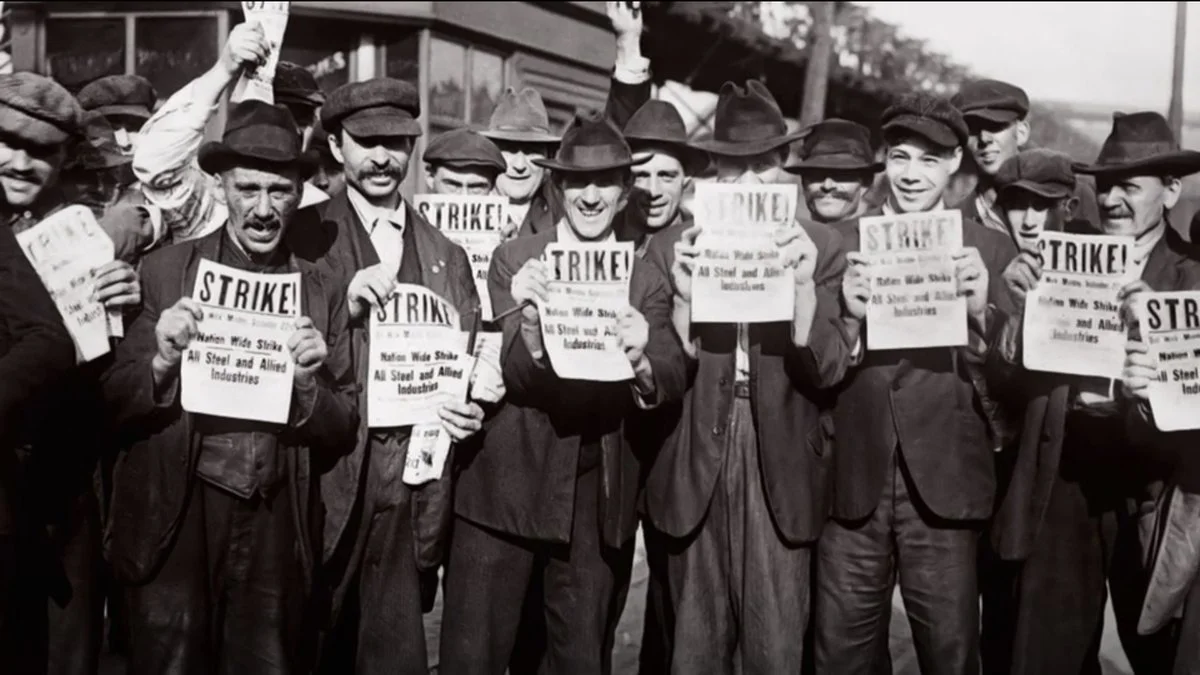
Striking Chicago steelworkers in 1919
As our brothers & sisters at Starbucks go on strike alongside thousands of other workers, Marxist Unity Group is proud to re-publish Stewart Bird and Deborah Shaffer’s play The Wobblies, which they used as the basis for the later documentary film of the same name. We will publish the second act, alongside an afterword by a MUG comrade later this holiday season.
Happy Thanksgiving Comrades, or Abolish Thanksgiving, you do you,
The Marxist Unity Group Editorial Board
The Wobblies, Act One
Cast of Characters
THE HEROES
Big Bill Haywood—The stubborn, proud, agitational, agitating, loud mouth, larger than life and pretty tall too, founding member and leader of the IWW.
J.T. “Red” Doran—Workers Professor of Economics of the IWW, author of several notable pamphlets and articles including “On the Road to Power” about the possibilities of organizing electrical workers.
George Francis Vanderveer—Bleeding heart ‘counsel of the damned’, got his start defending the civil liberties of Seattle’s mob.
Clarence Darrow--Founder of the ACLU, who during his career defended Eugene Debs, labor organizers, racial justice organizers, and the theory of evolution
Hooten & Tussy—Ill-intentioned Coloradoan labor militants
THE INTERNATIONAL WORKERS OF THE WORLD—At its peak
THE WORKING CLASS OF THE WORLD—In all its ingenuity and idiocy
THE JUDGE
Kenesaw Mountain Landis—Named after the battle of Kennesaw Mountain, the first commissioner of baseball and the levier of the heaviest fine ever given to a US company in 1909, $29,240,000 to Standard Oil for price fixing. By 1918 Standard Oil had been acquitted of the fine.
THE VILLAINS
Frank K Nebeker—Attorney for the railroads, prominent member of the Democratic National Committee
J. Edgar Hoover—Hard working wunderkind who, now at 24, was the youngest man ever selected to haunt all friends of freedom and socialism in this country
THE EMPIRE OF CAPITAL—In all its cruelty
Scene One — Cook County Courthouse, Chicago, Ill. 1918.
(A scrim covers the stage at the apron. As the house lights go down a slideshow is projected on the scrim. The soundtrack is synchronized with the slides. The slides begin with working conditions and union organizing 1900-1918. The music is ragtime; it changes to George M. Cohan and we see recruiting posters, soldiers marching, troop ships and scenes of the war in Europe. The music changes to IWW songs and we see pictures of workers, lumberjacks, farm hands, children in textile mills, organizers, demonstrators, picket lines, police troops and arrests. Finally we see newspaper headlines; the following voiceover is heard on the soundtrack. The slides continue of jail scenes, Chicago 1918, and headlines about the trial. The last slide is a rendering of the set.)
Jailer: What’s your name?
IWW Voice 1: Sam Scarlet.
Jailer: What’s your religion?
IWW Voice 1: The IWW.
Jailer: That ain’t no religion.
IWW voice 1: It’s the only one I got.
Jailer: Who’s your next of kin?
IWW Voice 2: Don’t have any.
Jailer: Well, who’s your best friend?
IWW Voice 2: Big Bill Haywood.
Jailer: He’s in here with you. He can’t help you.
IWW voice 2: He’s still my best friend.
Jailer: What’s your nationality?
IWW voice 1: None.
Jailer: Well, what country are you a citizen of?
IWW voice 1: I’m a citizen of industry.
Jailer: Where is your home?
IWW voice 2: Cook County Jail.
Jailer: Before that?
IWW voice 2: County jail, Cleveland, Ohio.
Jailer: And before that?
IWW voice 2: City Jail, Akron, Ohio.
Jailer: Look, are you a citizen?
IWW voice 2: No, I’m an Industrial Worker of the World.
(We hear a jail door slam shut. The slide on the scrim fades and the lights come up behind the scrim. We see Nebeker and Venderveer flanking a prospective juror. The juror does not answer but turns to each attorney as he speaks)
Vanderveer: Do you believe in slavery? That is, do you believe in chattel slavery, where the boss owns the worker, body and soul?
Nebeker: Do you believe in the wage system and the social system as it is now organized?
Vanderveer: Do you agree that most prostitution is caused because women in industry do not get living wages? Do you recognize the right of people to rebel against this injustice?
Nebeker: Have you any sympathy with any organization that seeks to overthrow the institutions of this country or to violate its laws?
Vanderveer: Do you believe in the right of the people to govern themselves and to have a voice in this government?
Nebeker: Do you believe that free speech gives anyone the right to advocate the breaking of the law?
Vanderveer: Do you believe that industry should make the laws for people to live by?
Nebeker: Were you in favor of the declaration of war against the Imperial German Government?
Vanderveer: Well, were you?
(The JUROR states first at one lawyer and then at the other, afraid to give any response)
Nebeker: I accept him.
Vanderveer: So do I.
(Judge Landis who had been watching the proceeding from the perch on the bench bangs his gavel. He is very mobile, frequently moving around the courtroom, sitting within the prosecutor the defense and the jury. He removes his robes on Nebeker’s next line and we see him in suspenders and shirt sleeves during the rest of the trial. The scrim opens.)
Landis: The federal district court of the First District, Chicago, Illinois, this day April first, 1918 is now in session. The case of the United States vs. William D. Haywood, et al. Having heard the reading of the charges...Mr.Nebeker? ...proceed.
Nebeker: May it please the court, gentlemen of the jury, this is not a flippant trial, this is not a minor trial, this is not the trial of a patriotic labor union, for the IWW can in no way be considered a labor union. It is in fact a criminal conspiracy which has obstructed the prosecution of the war against Imperial Germany. We shall prove that the IWW...
Landis: Mr.Nebeker, could you speak up please?
Nebeker: WE SHALL PROVE that the IWW is guilty of these things, gentlemen of the jury. Beyond the shadow of a doubt...Now the first charge let me enumerate...
(Nebeker continues in pantomime; the narrator enters. He is a middle-aged reporter; whenever he enters the set action continues in pantomime and he speaks to the audience.)
Narrator: Beyond the shadow of a doubt, you know it’s funny what you remember and what you forget. Now I usually can’t remember dates for nothing, anything to do with numbers, but can remember everyone one of Walter Johnson’s 56 consecutive scoreless innings in 1913 and Hippo Vaughn’s earner run average for 1917, an incredible 1.74; you all remember Hippo, he was probably the greatest and certainly the biggest pitcher in baseball. I watched him pitch for the Cubs against Boston, he had a screwball that looked like a figure eight.
But Ask me today’s date or when Arch Duke Ferdinand was assassinated or even why, I couldn’t tell ya. Now for me that’s a liability, I’m a reporter, cover sports and politics. Sports are a lot more exciting...except when the Wobblies were involved, they were like a fine baseball team, a lot of spirit, a lot of hussle, a lot of guts.
....and everyone remembers Ty Cobb, they can tell you all his statistics, there are people who can tell you his batting average for 1911, 420, or how many bases he stole in 1915 (96), but who remembers that one eyed giant over there, Bill Haywood, to me he was just as great; it’s a shame he didn’t go into baseball, besides knocking the cover off the ball, there would’ve been one hell of a player’s union.
It’s a good thing the trial didn’t overlap with the World Series, ‘cause Judge Landis had a private box right behind first base, Wrigley Field, and he would have adjourned the trial for sure. There he sits, a small man on a huge bench, a wasted man with untidy hair, the face of Andrew Jackson, three years dead. Judge Kenesaw Mountain Landis, named for a great civil war battle. It was Landis who fined Standard Oil 39,000,000 for taking kick-backs from the railroads. Of course, none of it was ever paid. He conducted this trial, like most of his trials, with the formality of a bar-room brawl.
Yeah! It’s funny what you remember. I’ll never forget that the day this trial started, One April 1918, April Fool’s Day; you should have seen that courtroom, I doubt if there’s been a sight like it. One hundred and one men, lumberjacks, harvest hands, miners poets, and they all believe the wealth of the land belongs to him who creates it and that’s what got them in trouble. It was like an all-star team of radicals. It was more like a convention than a trial, half the time, I didn’t know who was trying who.
(Nebeker picks up at the end of the speech and is addressing the jury, the narrator exits)
Nebeker: ...and so, gentlemen of the jury, having proven these things to you, I shall expect, I shall demand a verdict of guilty on each and every charge for each and every defendant, for we are locked in a Great War in Europe and to allow this kind of treason at home shall surely prove to our great disadvantage in the trenches of France, I thank you.
Landis: Thank you, counselor....Mr.Vanderveer? Does the defense wish to present an opening argument now?
Vanderveer: Yes we do, thank you, Your Honor. Let me open by saying that this case is unusual. It is supposed to be a case against William Dudley Haywood and a great number of other men that you’ve probably never heard of by name...100 other men, to be exact. Yet, in reality, this is not so. In reality, it is the purpose of the prosecution to destroy the union with which these men are connected. In simple terms, let me tell you what the defendants are charged with: conspiring to hamper the war efforts...conspiring...I’m curious to see how our esteemed prosecutor will prove this, since most of these men had not even met prior to their arrest. The prosecutor will also tell you the IWW is conspiring to destroy our government, but that is not so either. I want you to keep your mind on this one point, on the question of whether or not the purpose of this organization is to destroy the government or merely to change an industrial system which ought to be independent of our government...which ought to be under the control of the workers. We now live in what is considered the wealthiest nation in the world. But it is a nation in which 2% of the people own over 2/3 of all of its wealth. A nation in which 8/10 workers are utterly unable to support their families and educate their children on a plane of civic decency. Why is this, you might ask? Might it be because the monopolies and trusts are able to hoard huge profits for themselves and yet not pay a living wage?
Nebeker: I object, your honor. General industrial conditions are not involved in this case at all. Whatever those conditions are, they are based upon the law.
Landis: Overruled. Continue, Mr.Vanderveer.
Vanderveer: Thank you, Your Honor...a nation in which one man, reputed to be worth a billion dollars, owns more of the wealth of this country than two and a half million of the poorer families.
Nebeker: I object! How can the court allow counsel to defame one of the leading citizens of our country?
Landis: Sustained. Please stick to the issue, counselor.
Vanderveer: Of course...I’ll close by answering the charge that I’m certain the prosecution will return to again and again, in many guises. The charges that the IWW is not patriotic. Now if patriotism means to wave flags from the housetops and then profiteer, if patriotism means one must believe in war as the best way of settling things....that the wholesale slaughter of people is right...then the IWW is unpatriotic. But if patriotism is the belief in the people of the nation and the hope for their betterment, and the willingness of the people to work and fight and die for that betterment, then the IWW is patriotic without peer. These men are guilty of nothing more thna belonging to a labor union, a labor union that recognizes that this war is not being fought to keep the world safe for democracy but merely to expand industrial markets; men are dying right now, will continue to die simply to make the rich, richer....the IWW believes that if all workers recognized that, they would refuse to fight and there could be no war. Thank you.
Landis: Prepare to call your first witness, Mr.Vanderveer.
(Vanderveer moves to the defense table)
Haywood: Nice going, Van.
Doran: Yeah, great....
Vanderveer: Well, it’s a start.
Doran: Towards what? When you start something you gotta be going somewhere.
Haywood: What the hell are you talking about now?
Doran: I’m talking about a silent defense, no talking, not a word...let’s at least try to keep our self respect.
Haywood: Doran, you couldn’t keep your mouth shut for 5 minutes.
Doran: If you participate in it, you’re party to it, right?
Vanderveer: Don’t worry Red, just stick ot the defense strategy.
Doran: Look, I’m tired of this defense strategy crap. You got me to cut my hair, shave off my beard, I’m sitting here in somebody else’s suit...
Haywood: What’s a matter, you don’t like the cut, maybe we can take it in a little.... (indicating around Red’s neck)
Doran: What a joke...you know this whole thing’s being run from Washington
Haywood: Would you rather have it run from Wall Street?
Doran: That’s one hell of a choice.
Vanderveer: Listen, you guys, we got no problems, why half the gallery is filled with my creditors, waiting for me to win this case so they can get paid.
Doran: I hope you know where the backdoor is...sap.
(Vanderveer shakes his head and walks to the exhibits. Landis now in shirt sleeves and suspenders comes over to the defense table)
Landis: How you guys doing?
(Doran is like stone, continuing to read his paper)
Haywood: Hey judge, about this circus parade with the grub....
Landis: (in a congenial, helpful manner) Listen William, I’m gonna cut that out, there’s no need for you fellows to be marched through the streets in shackles just to get lunch. We don’t need to put on a show for those lunatics out there. From now on you eat at the courthouse. And if there are any complaints about the food or anything else, just tell Vanderveer and I will personally take care of it.
Haywood: That’s mighty considerate, Judge.
Landis: Don’t mention it. (Looking at Doran) Who’s throwing for Boston today? DOORen.
(Doran hands Landis the paper)
Doran: DoorANN, judge, it’s DoorANN. (to Haywood) Where are you and your friend lunching today, Bill?
Haywood: Ach! Get off my back, DOORen!
(Vanderveer returns to table)
Vanderveer: Well, you ready Bill? You’re on next.
(Haywood gives him a thumbs up sign but doesn’t look that good)
Vanderveer: What’s a matter Bill? Don’t tell me Red’s getting to you?
Haywood: Well if you’d been in a cell with him for eight months...he’s got his head stuck in the sand.
Doran: You’re the ostrich, sap....I know a necktie party when I see one.
Haywood: The problem with you, Doran, is that you can only see things one way, and right now it’s the wrong way.
Vanderveer: I call William D. Haywood, for the defense.
(Haywood moves to the stand)
Doran: Wrong way for who, you or us?
(Haywood hesitates but continues to the witness chair. Haywood is sworn in and takes the stand)
Vanderveer: Your name is William D. Haywood?
Haywood: Yes, sir.
Vanderveer: How old are you?
Haywood: Forty Nine.
Vanderveer: You are now General Secretary of the Industrial Workers of the World?
Haywood: Yes, sir.
Vanderveer: How long have you occupied that position?
Haywood: Three years.
Vanderveer: What line of work have you followed, Mr. Haywood?
Haywood: Mining, principally.
Vanderveer: At what age did you start out in the world to make your own living?
Haywood: You mean when I first began working?
Vanderveer: Yes.
Haywood: Well, I was still living at home then. I was a little less than nine years old.
Landis: How old were you, Mister Haywood?
Haywood: Nine years old.
Landis: Excuse me, what is your background, I mean what did your father do for a living?
Haywood: He was a pony express rider, but he died when I was very young.
(Landis motions to Vanderveer to continue)
Vanderveer: What kind of work did you do then, when you were nine years old?
Haywood: I was helping my step-father in the mine.
Vanderveer: In what way?
Haywood: Twisting drill, carrying steel and water, blowing the bellows.
Landis: Excuse me again, but how did you lose that eye, William? I’m curious about that.
Haywood: I was working at the Couer d’Alene, copper mine, 12 hour shift. We were going down in the cage to the shaft house floor, the cable pulled loose and dropped us forty feet down the shaft, a pick went through the eye. But I was lucky, two men died. We found out later the company had neglected the usual precautions and the hoist engine brakes were out of order.Landis: Thank you William, go ahead.
Vanderveer: Where was I, Bill?
Haywood: You were asking me where I worked when I was nine.
Vanderveer: Oh yes, what other work did you do as a young man?
Haywood: When I was eleven, I was bound out to work on a farm. My main job was driving a yoke of oxen. I was only a kid, I guess I wasn’t going fast enough. The farmer picked up a bull whip and struck me without saying a word. I ran straight to the house, gathered my belongings, and started for home. I guess you could call that my first strike.
Vanderveer: When did you first get involved with unions?
Haywood: When I first went to work in the mines, on my own, I met the older miner in the camp, he was a member of the Knights of Labor, his name was....uh....
Doran: Pat Reynolds.
Haywood: Yeah, Pat Reynolds, well he pointed out that the man eating with us, the boss, was not the real owner of the mine. The owners lived in California while the men who did all the work and made the mines of value were there in the wilderness of Nevada. I soon learned that it was necessary for working men to organize for mutual protection and that’s what I’ve been doing ever since.
Vanderveer: What’s the first union you joined?
Haywood: The Western Federation of Miners.
Vanderveer: While you were a member of the Western Federation of Miners, did you go through any strikes in the mining industry?
Haywood: While I was on the executive board, there were a number of strikes.
(Narrator enters)
Narrator: You can say that again, the Western Federations of Miners, more like a war. Damn, they were my first big assignment out of New York City. I got off a stage coach in Cripple Creek, Colorado...started asking questions and wound up in the can...that’s where I first met Big Bill, we hit it off right away....he sort of broke me in you might say, I’d never seen a strike, close up, before. I always figured it was picket lines and negotiation....but the Western Federation set me straight about that...these guys were at war and I do mean war and everybody that was invited came, including the militia....
The militia, if you all think about the militia as a peace keeping organization, you don’t know nothing about Colorado in 1903. No sir...the militia was busy....destroying union halls....loading strikers on the trains, shipping them out into the wilderness and dumping them. Of course, the strikers didn’t always go along peaceable...they liked living in town, you know, with their families....
The war was over the 8 hour work day, the Colorado legislature had passed an 8 hour work law but unfortunately the governor, the mine owners, and the militia didn’t agree....and that’s the way I wrote it, and the New York American reported it, on page 18....I got a wire fr om the editor saying he wasn’t interested in politics, said he wanted headlines...
(Narrator exits)
Haywood: (Speaking primarily to the judge, who is standing near to the witness box)....Well we had been playing cards for a couple hours and suddenly as I was about to leave I noticed all of us had something in common, all five of us only had one eye. Ha ha ha...
Vanderveer: That’s all for now, your witness.
Landis: There will be a five minute recess. Mr.Nebeker, I’d like to speak to you please.
(Haywood leaves the stand, he, Vanderveer, and Doran come together in the center of the court room; all others exit)
Vanderveer: Bill, I thought you lost that eye when you were a kid, playing with a jack knife.
Haywood: Who told you that?
Vanderveer: Well, I think you did.
Haywood: No, you musta heard that from one of the boys...maybe Doran told you that.
Vanderveer: No, you told me Bill.
Doran: Yeah! Why don’t you tell the truth! Everybody knows you lost it in a fight in some whorehouse in Wichita.
(Doran exits)
Haywood: Don’t start ugly rumors. I only lost the one eye. You know how bad conditions are in the mines, it musta been in a mining accident...Doran, wait a minute.
(Haywood exits)
Vanderveer: Bill, you’re on the stand, under oath, you can’t be telling stories...
(Vanderveer exits)
SCENE TWO — Outside the Silver Nugget Saloon, Colorado, 1903
Tussy: I’m getting tired of this strike, I’ll tell you that. We ain’t gettin’ no where but poor.
Hooten: Well, we ain’t going back to work ‘til the law is obeyed and the law says 8 hours.
Tussy: Ain’t nobody talking about going back to work. We’re talking about doing something for ourselves.
Hooten: Tussy, you know what Bill said about talk like that!
Tussy: ...he’s been in Denver for too damn long. He start forgettin’ what it’s like out here.
(Haywood enters)
Haywood: Howdy, boys.
Tussy: Bill, Bill, how you doin’? Come on over here, what happened at the meeting, we been waitin...
Haywood: Negotiating committee met with all the mine owners’ people today...had an agreement hammered out to go back to work...8 hours...$3.50...but McNeill wouldn’t go along...pressured all the others into backing him up, so we’re gonna’ have to stay out a little longer.
Tussy: McNeill, you know he’s shippin’ so many scabs in here...every day...he had to have extra cattle cars put on. But don’t you worry about nothin’ Bill, we know how to handle him and his scabs...
Haywood: You know there are times, we got to put up with scabs; there’s times we get too hungry, we even got to do a little scabbing ourselves.
Tussy: Yeah! But there aint’ never no time when we have to put up with no spies. Me and Hoot caught us a spy today, cracked his skull and ran him out of town....hehehe
Haywood: Who was he, what was his name?
Tussy: Never did catch his name....hehehe
Haywood: Well, I guess we get can get away with a little rough stuff with a two-bit spiy....
Tussy: Yeah, that two-bit McNeill is gonna see a little of it too, hehehe
(Haywood is suddenly very serious, grabbing Tussy)
Haywood: What does that mean, Tussy?
(Tussy realizes he has slipped)
Tussy: Well...uh....I just heard some of the boys are planning on bushwacking him.
Haywood: Some of the boys, huh? Well you find some fo the boys and you TELL them why we lose strikes, because some idiot started shooting when he should have been thinking...if the governor sends the troops in here I’m commin’ looking for YOU, TUSSY!
Hooten: Bill, we can’t be watching all our people all the time.
Haywood: Hoot, you know better than anyone, you were in the bull pens, if the troops come here, we lose this trike...try and get that through his head.
(Haywood exits)
Hooten: You know he’s right, Tussy.
Tussy: Yeah! Maybe...but if he aint’ maybe it’s time we let the cat loose
(showing three sticks of dynamite)
Hooten: You remember what he said about the troops...
Tussy: I remember, I aint’ stupid, but I’m gettin’ damn tired of being kicked around. If things don’t get better soon...
(Tussy exits. Hooten shakes his head, looks in the direction that Haywood exited and then in the direction that Tussy exited)
Hooten: Tussy...Tussy...
(Hooten exits, trying to catch up with Tussy).
SCENE THREE — Chicago, 1918
Narrator: Well, it wasn’t long before my editor got all the headlines he wanted...it was called the Colorado Civil War, half the mines in the state were blown up ... even an ex-governor was killed...the mine owners tried to pin the whole thing on Bill...they hired the Pinkertons to kidnap him, shipped him off to Boise, Idaho for trial. That was in 1907, this time I was working for the New York Call, papers from all over the world were there, couldn’t get near the telegraph office...miners came from all over the west...more pinkertons than you could shake a stick at...now Haywood had been in and out of jails all over the west...but this time he was in real trouble nad he knew it, so the Western Federation sent to Chicago for Clarence Darrow...best defense in the country....odds makers made it 4/1, state of Idaho.
(Narrator exits, Darrow exits)
Darrow: I don’t know, Bill, things are gettin’ tough...
Haywood: Cheer up, Clarence, we’re the ones who are gonna hang.
Darrow: I dunno, Bill, the pressure must be gettin’ to me. They got two goons following me around, they open my mail, tap my phone...
Haywood: Clarence, look, I’ll get some of the boys to pay a little visit...
Darrow: No, don’t both.
Haywood: No trouble at all...
Darrow: NO, please...I’m putting you on the stand tomorrow, but I don’t want any rough stuff, no politics, no nothing. Just sit and answer my questions, you can understand that...
Haywood: Listen, Darrow...
Darrow: I don’t want to hear it, Bill, this is a murder trial, get that through your head...you weren’t arrested for loitering this time.
Haywood: Listen Darrow, this is a political trial, that’s why I wanted Debs here, that’s why I wanted to get this out in the open to the workers.
Darrow: Debs? Look at this: “Arouse ye slaves, the crisis has come...if they attempt to murder Haywood, a million revolutionaries will meet them with guns”...do you think we can win in Boise, Idaho, with that, is that what you want to pin your defense on?
Haywood: You were hired to be my lawyer, not my mentor! There are important political issues here, that you are not dealing with. They are trying to destroy the Western Federation. There is a conspiracy between the mine owners and the state officials to get rid of us, that’s what you pin the defense on.
Darrow: Is that what you want? Cause if you do you’ll drag the whole federation down with you...
Haywood: I want Debs...
Darrow: You got him. There’s a train leaving for Chicago at 7 o’clock, I checked the timetable. Make up your mind...
(Haywood submits)
Darrow: I got some papers I want you to look over
(Lights focus on Darrow, he speaks to the audience)
Darrow: There’s no doubt that Haywood is completely innocent in the Steunenberg killing, but what I’ve come to realize is that I don’t like Bill Haywood. He believes in force and has used force. I’m certain he is guilty of many acts of violence against property rather than persons, crimes well provoked, but nonetheless crimes which will lead the labor movement down the wrong path.
(pause)
And he’s so damn sure of himself. Once he said, “I”d like to blast every mine owner out of the State of Colorado.” and it’s certain he would if he could. I can’t go along with that. I’m a pacifist, I won’t tolerate violence.
Haywood (angry and speaking to the audience): Darrow’s a brilliant lawyer and we stand side by side in that court room, but we really don’t see eye to eye. Someone I do see eye to eye with is Gene Debs, one of the greatest socialists in this country. I wanted Debs here, I wanted rallies, I wanted mass meetings, I wanted a vigil ringing the court house, Debs could do all that and more, you can talk with that man, he listens and he understands the worker’s struggle. That’s why I wanted him here, I have searched my mind for Darrow’s objections to Debs. Maybe he just wants all the limelight for himself.
(Darrow is speaking to the jury, but he speaks to the audience)
Darrow: I want to speak to you plainly. Mr. Haywood is not my greatest concern. Wherever men have looked upward and onward, forgotten their selfishness, struggles for humanity, worked for the poor and the weak, they have been sacrificed. They have been sacrificed in the prisons, on the scaffold, in the flame...if you kill him your act will be applauded by many; if you decree his death, among the spiders of Wall street will go up paeans of praise. In almost every corner of the world, where men wish to get rid of agitators and disturbers, you will receive blessing and praise that you have killed him...but if you free him, out on our broad prairies where men toil with their hands, out on the broad oceans, where men are sailing the ships,s throughout our mills and factories, down deep under the earth, thousands of men, of women, of children, weary with care and toil, will silently thank you, as I do now..
(Darrow exits)
SCENE FOUR — Chicago, 1918
(Narrator enters)
Narrator: Bill was acquitted, but that was Boise, Idaho in 1907, not here in Chicago in 1918... Darrow believes the problem with this case was that Haywood was running the defense, why Darrow even offered to help, said he helped write the Espionage act in Washington, he should have known the loopholes, but Bill turned him down, can you beat that?
(Narrator exits, during the narrator’s speech the court room was filling up, Landis raps his gavel.)
Landis: Let’s get going, Mr. Nebeker
Nebeker: Your honor, before proceeding with the cross examination of this witness I would likt to read some of the songs the IWW uses to advocate violence. This organization sinks to the lowest levels by taking Christian hymns and American patriotic songs and by changing the words for their own sinister ends. Possibly the worst of all is their use of songs to advocate sabotage, as in this one “I have a job once threshing wheat, worked sixteen hours with hands and feet...”
(the ensemble enters and picks up the tune of the song Nebeker is reading. They sing the song to the audience while Nebeker continues to read in pantomime.)
Ensemble: (to the tune of “Ta ra ra boom de ay”)
I had a job once threshing wheat, worked sixteen hours with hands and feet,
And when the moon was shining bright, they kept me working all the night.
One moonlight night, I hate to tell, I accidentally slipped and fell,
My pitchfork went right in between some cog wheels of that thresh machine
Ta ra ra boom de ay
It made a noise that way, and wheels and bolts and hay, went bullying every way.
That stingy rube said, “Well, a thousand gone to hell”
But I did sleep that night. I needed it all right.
But still that rube was pretty wise, these things did open up his eyes
He said “there must be something wrong, I think I work my men too long”
He cut the hours and raise the pay, gave ham and eggs for every day
Now gets his men from union hall, and has no accidents at all
Ta ra ra boom de ay
That rube is feeling gay, he learned his lesson quick, just through a simple trick
For fixing rotten jobs, and fixing greedy slobs, this is the only way
Ta ra ra boom de ay
(The ensemble crosses on the song and resumes their places in the jury box)
Nebeker: this is the only way, ta ra ra boom de ay” I think that I will have the rest of the songs read into the record later, and get on with the cross-examination of Mr.Haywood.
(Nebeker motions to Haywood to take the stand, he does)
Nebeker: Now, Mr.Haywood, it seems that labor disturbances and violence have followed you throughout your infamous career...and not just with the IWW, but even earlier with the Western Federation of Miners. You were involved with the Cripple Creek Strike, weren’t you Mr.Haywood?
Haywood: Yes, I was there.
Nebeker: When the miners decided to take over the mines?
Haywood: They didn’t try to take over the mines. THey just walked out. Those men were working twelve hours a day, in total violation of the eight hour law.
Nebeker: Come now, Mr.Haywood, weren’t the authorities aware of this condition?
Haywood: OH yes, indeed.
Nebeker: Was the law inoperative, or...why else wouldn’t they prosecute the officials?
Haywood: You’re the attorney for the justice department, did you ever hear of a mine owner being prosecuted for violation of a law that protects a miner?
Nebeker: Well, anyway, there was trouble between the mine owners of Colorado and the Western Federation of Miners?
Haywood: Yes, there was.
Nebeker: Trouble began, the trouble began around the time you landed in Colorado in 1901, didn’t it?
Haywood: No, the trouble began long before that, in 1880, the first strike was in Leadville, and there was a strike in Cripple Creek.
Nebeker: Well...
Haywood: There was also the Leadville strike of 1896.
Nebeker: Yes, but...
Haywood: There was also the mill strike of 1899.
Nebeker: (Unable to get in a word)
Haywood: All those strikes had taken place before I came to Colorado.
Nebeker: But things did start to really pick up as soon as you did get there, didn’t they? Who was the governor of Idaho at the time of the Couer D’Alene trouble?
Haywood: Steunenberg...governor Steunenberg.
Nebeker: Did anything happen to Governor Steunenberg?
Haywood: He was blown up.
Nebeker: Blown up? Could you be a little more specific?
Haywood: Well, from what I was told, he was coming out of the house and when he opened the gate of his picket fence there was an explosion and he was killed.
Nebeker: you were indicted for that murder, weren’t you?
Vanderveer: I object, Haywood was acquitted of all connection with that crime.
Landis: Sustained
Vanderveer: Jesus Christ...
Landis: Continue, Mr.Nebeker.
Nebeker: So, Governor Steunenberg was, as you say, BLOWN UP after his stand against the Western Federation...is that right?
Haywood: That happened years after the Couer D’Alene fight.
Nebeker: How long after, Mr.Haywood?
Haywood: I don’t know...six years? About six years.
Nebeker: But isn’t one of the mottos of your organization, “We Never Forget”?
Haywood: Are you referring to the IWW?
Nebeker: The IWW.
Haywood: It was not even in existence at that time.
Nebeker: But isn’t one of the slogans of the IWW: “We Never Forget”?
Haywood: That was...that’s not a slogan...it’s sort of...the words have been used, but
Nebeker: Isn’t it in your papers, and in your pamphlets, and on the stickers, and in thousands of places in the literature and writings of your organization?
Haywood: Let me tell you where it was first used...
Nebeker: Just answer the question first!
Haywood: Yes, now let me tell you where it was first used.
Haywood: I first used it on a program for the funeral of Joe Hill, in 1915.
Doran: Amen!
Nebeker: the first time?
Haywood: Yes, the first time.
Nebeker: Are you sure, didn’t you use the phase when you were a member of the Western Federation of Miners?
Haywood: I don’t believe so, no.
Nebeker: No...well I say you did
(Nebeker picks up a newspaper from exhibit box)
Nebeker: WE NEVER FORGET, it was published in nineteen hundred and twelve.
(Nebeker hands newspaper to jury)
Nebeker: And isn’t it also true that the violence used and fostered by thr Western Federation of Miners developed into the very basis of the IWW?
Vanderveer: I object! That has nothing to do with...
Landis: Overruled.
Vanderveer: ...The Western Federation never did anything more violent than protect themselves, their families, and their jobs. Those miners were being...
Nebeker: Thank you, Mister Haywood.
Haywood: Judge, where the hell is he, I thought you wanted to hear this, judge?
Landis (seated behind Doran at the defense table) Yes, I do. Go ahead, William.
Haywood: You see, the miners were on strike in one section of Colorado and the mill workers were on strike in another. The mill men were scabbing in the mines and the miners were scabbing in the mills. They were destroying each other’s unions! That was the basis for the one big union.
Nebeker: That’s all very interesting, Mr.Haywood. However, I’m talking about the thousands of documented cases of violence and sabotage committed by the IWW and the WFM and all the other radicals you are associated with.
Vanderveer: I object! There is no evidence...
Landis: Overruled.
Nebeker: I’m talking about the blowing up of Governor Stuenenberg, the shooting of Mr. Frick, the blowing up of numerous mines and mills...the blowing up of the Los Angeles Times....isn’t this the kind of violence you advocate? Don’t you want to destroy the existing order of things and doesn’t that require violence? Don’t you believe in extremes, violent extremes, Mr.Haywood?
Vanderveer: I object.
Haywood: I’ll answer that, Van. The IWW advocates violence of the most violent sort. Violence that consists of keeping our mouths shut and our hands in our pockets. In doing this and staying on strike we are committing the most violent of acts, cutting off our labor! It is the most violent act we can commit against the capitalist, for it hurts him in his bank account, the only heart he has.
Nebeker: Thank you, Mister Haywood.
Haywood: But don’t get me wrong, we are against the blood in the streets kind of violence.Those actions come out of a feeling of impotence, and we wouldn’t be here today if we were important, would we Mr.Prosecutor?
(Haywood has taken control and Landis, seeing this, bangs his gavel several times)
Landis: Court’s adjourned til Monday morning at 9AM!
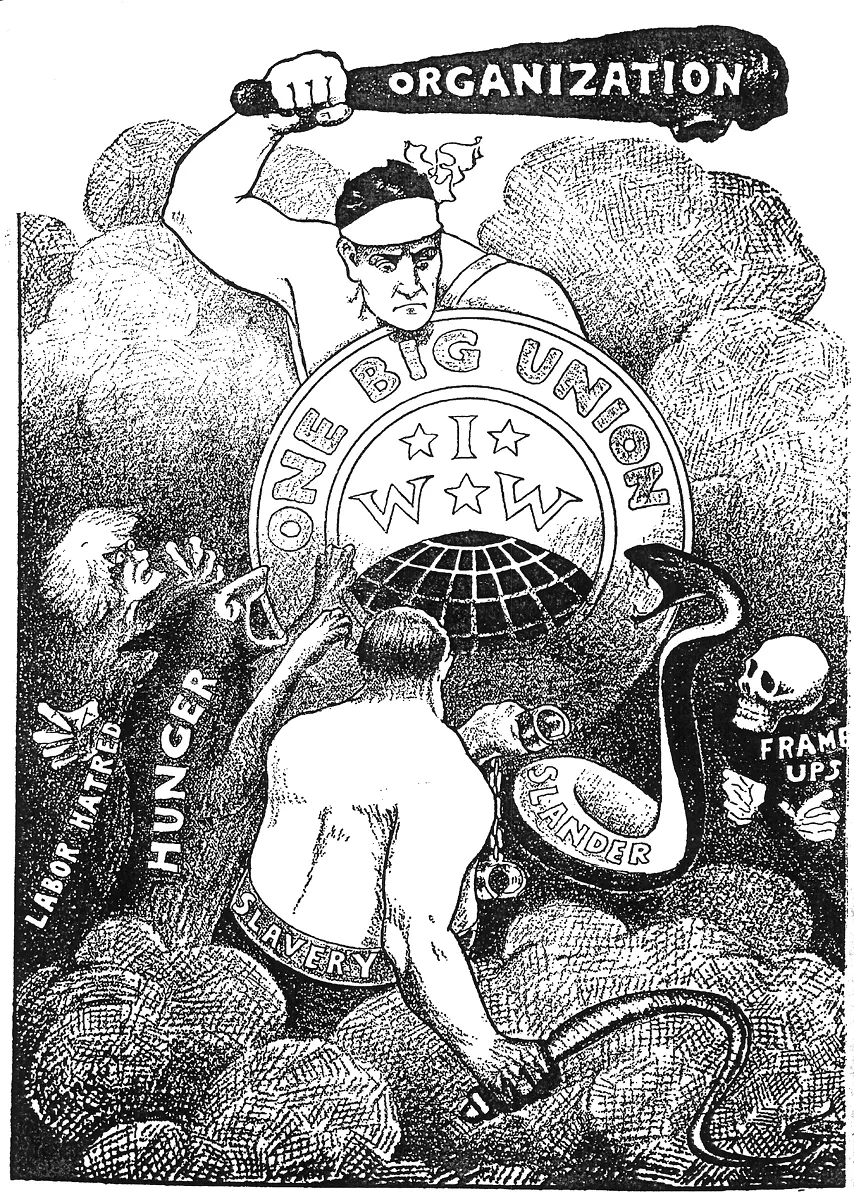
Ralph Chaplin, Solidarity
SCENE FIVE, CHICAGO, 1905
(Narrator Enters)
Narrator: Nebeker was no fool to hear him talk ...thousands of cases of violence destroying the existing order...German gold in IWW pockets. It seems to me that this war has got people so worked up. They don't know what to think.Even darrow, why he said “while pacifism as a principle was fine during the peace, it was not worth a hoot in hell during wartime.” But not bill, he's always been consistent. He always believed workers should not shoulder arms against each other.Bill didn't care if they were german or american to him, a worker was a worker. Thatwas a cornerstone of the IWW founding convention at Brandt hall, right here in Chicago in 1905.
(Haywood has moved to the table, he has a piece of lumber which he uses as a gavel)
Haywood: Fellow workers, this is the continental Congress of the working class. It has been said that the purpose of this convention was to form an organization to rival Sam Gompers's A F of L. That is a mistake. We are here for the purpose of organizing a LABOR organization. There are A F of L locals that refuse to admit a colored man that refuse to admit foreigners that totally refuse to organize women or children that they have made America the land of the lost strike. Their high initiation fees, their caste system, and their partnership with capital. What we want to establish at this time is an organization that will open wide. Its doors to every man or woman who earns their livelihood by brain or muscle. I don't give a snap of my fingers whether skilled workers join this union or not. We don't need them. There are thirty five million workers in this country that aren't organized yet. And it doesn't make a damn of difference whether he is black or white, an American or a foreigner. I am still of the opinion that an American is just as good as a foreigner so long as they behave themself. Thank you. This is your convention, so make the most of it. Come on, boys!
(Ensemble enters and sings to the tune of the rambling wreck from Georgia tech)
Ensemble: We’re anarchists and socialists and dynamiters too
We’re the slaves of Wobbly delegates that tell us what to do;
There’s nothing we should kick about, we all got gall sublime,
But we’re bone and sinew of the land about election time.
We’re wild eyed hayseed, lazy shirks, agitators, knaves
We’re looters of the vaults of wealth and our speakers always rave
We’re a danger to the country and republic all the time
But we’re honest sturdy farmers at about election time
Yes we’re valiant hosts of labor at about election time
We’re the thinking toilers of the land about election time.
(Ensemble exits, stage is empty)
SCENE SIX — Chicago, 1918
(Hoover enters; he is standing around waiting. We hear Landis’ first line off stage as he enters)
Landis: Morning, Joe, Cubs are doing fine, looks like they’ll be in the series this year.
(Landis enters)
Hoover: Judge Landis! How do you do? My name’s Hoover, special assistant to Attorney General Palmer.
(Landis walks)
Hoover: Sure is hot in Chicago this time of year. Cubs look like a winner this time.
(Landis stops and looks at Hoover)
Hoover: I hear you’re a big fan.
Landis: Yeah, it looks like they’ll be in the series this year if their pitching holds out.
Hoover: When do you think it’ll be over?
Landis: The season? That usually runs into September
Hoover: No, the trial.
Landis: That’s hard to say. It looks like they will be at each other’s throats for a couple of months yet.
Hoover: But it’s already July, that’s almost four months gone by. People in Washington are getting a little concerned that this might drag on for too long. The country is getting worked up over these traitors. Real scum, ya know.
Landis: Hoover, you got a lot to learn...if Bill Haywood heard you, he’d kick your ass all the way back to Washington.
Hoover: Attorney General Palmer sent me out here to...
Landis: Now, just wait a minute! Palmer’s never presided over an IWW trial and I doubt if you’ve ever presided over anything. You see, this is my ball park, I’m the ump here, I make the calls.
Hoover: Look, Judge Landis, we have already replaced one prosecutor, it’s not out of the question to--
Landis: Now don’t say something stupid, Hoover!
(Hoover starts to exit)
Landis: HOOVER! Never underestimate people with a mission. Now I know what they’re capable of and what their weaknesses are and I’m going to give them plenty of rope. When you’re dealing with people with a cause you got to have respect.
Hoover: Respect? What kind of respect?
Landis: No, not respect...affection...you know? I’ve really come to like some of these guys. You know when a visiting team comes into a ball park and they’re hot, their pitcher has really got smoke on his fast ball and they’re ready to clear the bench at any moment, you can really appreciate a team like that.
(Hoover shakes his head)
Hoover: that’s all very interesting but...are you aware that the Bolsheviks have overthrown the Tsar and that there are revolutionaries all over our country with similar intentions? This is not quite a baseball game, Judge Landis.
Landis: Hoover, you’re hopeless. Just go home to Washington and tell Palmer everything’s under control.
Hoover: I’m not an errand boy; I was sent here with very clear instructions.
Landis: Good day, Mr. Hoover.
(Hoover exits. Narrator has been watching the end of the scene from the shadows)
Narrator: The truth, the whole truth, and nothing but the truth, so help me god...You know, the truth is a funny thing. Sometimes you have to dig for it and sometimes it hits you right in the face. I once worked for a socialist editor, he told me to never see a striker hit a scab, always see the scab hitting the striker. YOu see, there were seven or eight papers who’d always print it the other way, he thought he’d keep the balance. At least he was honest with me.
(Court is called to order as court room fills up)
Landis: Mr. Vanderveer, call your next witness.
Vanderveer: I call Mr.J.T. Doran for the defense
(Doran is sworn in and takes the stand)
Vanderveer: When did you come into the Industrial Workers of the World?
Doran: As soon as I discovered they were in existence.
Vanderveer: What was the reason for your going into the Industrial Workers of the World at that time?
Nebeker: I object, Your Honor, we have been through all this before, the defendant’s motivation is of no significance in this case.
Vanderveer: Your honor, the defendant is going to tell the jury first hand what the IWW advocates.
Landis: Sit down, Mr.Nebeker, let’s hear what he’s got to say.
(Landis gestures to continue)
Vanderveer: Tell me, Red, why did you join the IWW?
Doran: Well, I’d been around the country a good deal at my trade, and I found that conditions on the jobs were so poor that something had to be done.
Vanderveer: What is your trade, Red?
Doran: I earn my way as a mechanic, work on big engines, mining camps, lumber mills...but actually I’m a WPE.
Vanderveer: WPE?
Doran: Worker’s Professor of Economics.
Vanderveer: Now, I understand that you traveled around from camp to camp organizing, and made this presentation to educate the workers. When you wen to make your talk, what subjects did you talk on?
Doran: Well, I used what I’m pleased to call a chalk talk, using crude illustrations, a blackboard and a piece of chalk.
(Holding up a piece of chalk)
Vanderveer: The talk that you gave, was that substantially the same at the various places where you--
Doran: Always the same, that is, I did not recite it poll-parrot fashion, but the substance did not vary.
Vanderveer: you’re on, Mr. Doran
(Vanderveer hands blackboard to Doran. Doran moves to stage center, smiles at the audience, raises and lowers his eyebrows several times, tries to see the faces of the people in the audience, smiles, takes a deep breath)
Doran: Compadres, Copanes, Kung Yow Moon, fellow workers, you have heard a great deal about the IWW, and you know what people say about us. The sheets usually credit us with being a bunch of murderers, a lot of irresponsible dynamiters and agitators.
The IWW does not ask you as a working man to do a single solitary thing that you do not already do. We ask you to do in the interest of humanity in the interest of yourself and your wife and your babies just what you do in the interest of economic waste, the profit holders. Don't let me get away from you, you see. We, the IWW suggest something we suggest doing away with capitalism. Why? Because we find it objectionable. We suggest tearing it down, but we are not destructionists. We propose to tear it down, but we propose to put something in its place, and what is that thing we propose to put in its place? Socialism. Now don't get scared! Because before you can understand socialism, you have to understand capitalism. The system under which you now work. But before you can understand capitalism, you gotta understand surplus value. That's right, surplus value, surplus! So let's deal with surplus value. This here is a factory, a farm, a mine, a timber mill, any means of production.
(He draws a box on the board)
Each and everyone one of you walks in in the morning and out at night.
(He draws little lines going into the box and lines going out)
And what do you get for your hard labor, for your sweat, for your dreary days and tired nights?
(He turns the lines coming out of the box into small dollar signs)
Not much, ‘wages’ they call them, slave wages I say, a mere token, hardly enough to live on Now that factory or mine makes big money.
(He draws a huge dollar sign at the bottom of the board beneath the box)
On any day’s shift a worker produces say two dollars worth of goods. Thirty dollars go into overhead and materials...
(he draws a roof on the box and smoke coming out of the top)
Two dollars go to you...that leaves 168 dollars and what happens to those 168 dollars? That is, the unpaid wages, the profits, the SURPLUS VALUE. Who gets that surplus value? Not you or me. What happened to it? We must have lost it!
(He turns board, looking for the 168 dollars)
Under socialism, workers wouldn’t lose that surplus value, it would be theirs, yours, because you would own the mine. Now someone might say the capitalists own the mines and have a right to keep them. But let me tell you a story about gold mines. The absentee owner did not find the gold, he did not mine the gold, he did not mill the gold, but by some strange alchemy, he owns the gold--all the gold belongs to him. Now think about that.
Nebeker: This is a conspiracy to take from the owner what is constitutionally his and in the ownership of which the law supports him.
(During this interchange Doran erases drawing and draws a cartoon of Nebeker’s face and writes FOOL on it)
Landis: Please, Mr.Nebeker.
Nebeker: The wage system is established by law and all opposition to it is opposition to law.
Landis: Mister Doran has an interesting theory, Mr.Nebeker, you must admit. Although it is as irrelevant as the Holy Bible. Continue, mister Doran.
Doran: Now let’s look at this from another angle:
(flips the chalk board over, there is a pyramid drawn on the board.)
Doran: Now, this great mass of men and women on the bottom here, represented by this line, are the workers, their activities in any business are governed by another element known as the straw-boss element, they’re just like you and me, but they’ve been bought off, been bribed, for an extra half dollar...
(he pulls a half dollar from the ear of a jury member)
...and he looks out for the interests of the owners rather than himself
(Landis walks over to see better)
Doran: And then, supervising the activities of the straw-boss element is the foreman element, the push. Now it takes a little more to buy him off, maybe and extra dollar.
(Doran pulls a dollar out of Landis’ pocket)
Supervising the foreman is the general foreman, the superintendent, the manager, the general manager, and then the economic waste, the profit-holders, the bond-holders, the people who do not do anything, and that is where the surplus value goes. Gabish, Verstehen, Savvy, do you understand? I usually end by passing the hat, but considering the circumstances, I guess we can dispense with that today.
Landis: Yes, you can, Mr.Doran.
Vanderveer: Your witness.
(Nebeker pauses, Doran sits, uneasy)
Nebeker: How many times have you been arrested, Doran?
Doran: I’ve been persecuted and arrested a number of times, never tried.
Nebeker: Answer the question, how many times have you been arrested?
Doran: In Los Angeles they arrested me four or five times a week for months and never let me see a judge, Judge.
Nebeker: How many times have you been arrested?
Doran: I don’t know, lots of times on that kind of charge, I was never convicted of a felony in my life.
Nebeker: Have you been arrested a dozen times?
Doran: Yes, several dozen times, at least.
Nebeker: Could you repeat that?
Doran: Several dozen times.
Nebeker: In every case you were in the right and they were in the wrong, I suppose?
Doran: They never tried me.
Nebeker: Answer the question.
Doran: I don’t know, they never took it to a showdown; I presume I was right.
Nebeker: So, you have been persecuted by the Justice Department?
Doran: Yeah.
Nebeker: Are you telling this court there is a conspiracy in the United States Government to persecute Mr. JT Doran?
Doran: I say there is a capitalist conspiracy in this country to oppress the workers.
Nebeker: So what you are really saying is that justice as it is in this country is capitalist justice?
Doran: Yes.
Nebker: THere is no justice for the workers in the courts?
Doran: No.
Nebeker: That all the courts are what you would call capitalist courts?
Doran: Yes.
Nebeker: you don’t believe there is any justice to be had in this court, do you?
Doran: I don’t think I can get any justice from a Copper-Trust-dumb-lawyer-son-of-a-bitch like you.
Nebeker: (To Landis) Does this counsel have to put up with this lowlife?
(Doran goes for Nebeker, jumping over the railing)
Doran: You miserable bastard, you know this whole trial is a big frame up!
(Haywood restrains Doran; Vanderveer shaking his head walks off; Landis, enjoying himself, waves Nebeker back. Haywood tries to hold Doran)
Doran: Why don’t you just hang me right now, like you hung Frank Little. You son of a bitch, this ain’t no trial, this is a lynch mob. The working class and employing class have nothing in common. Bill, let go a me! Goddamn it...