


If I make this Earth a metaphor I make a metaphor against the police.
— Miguel James, Against the Police
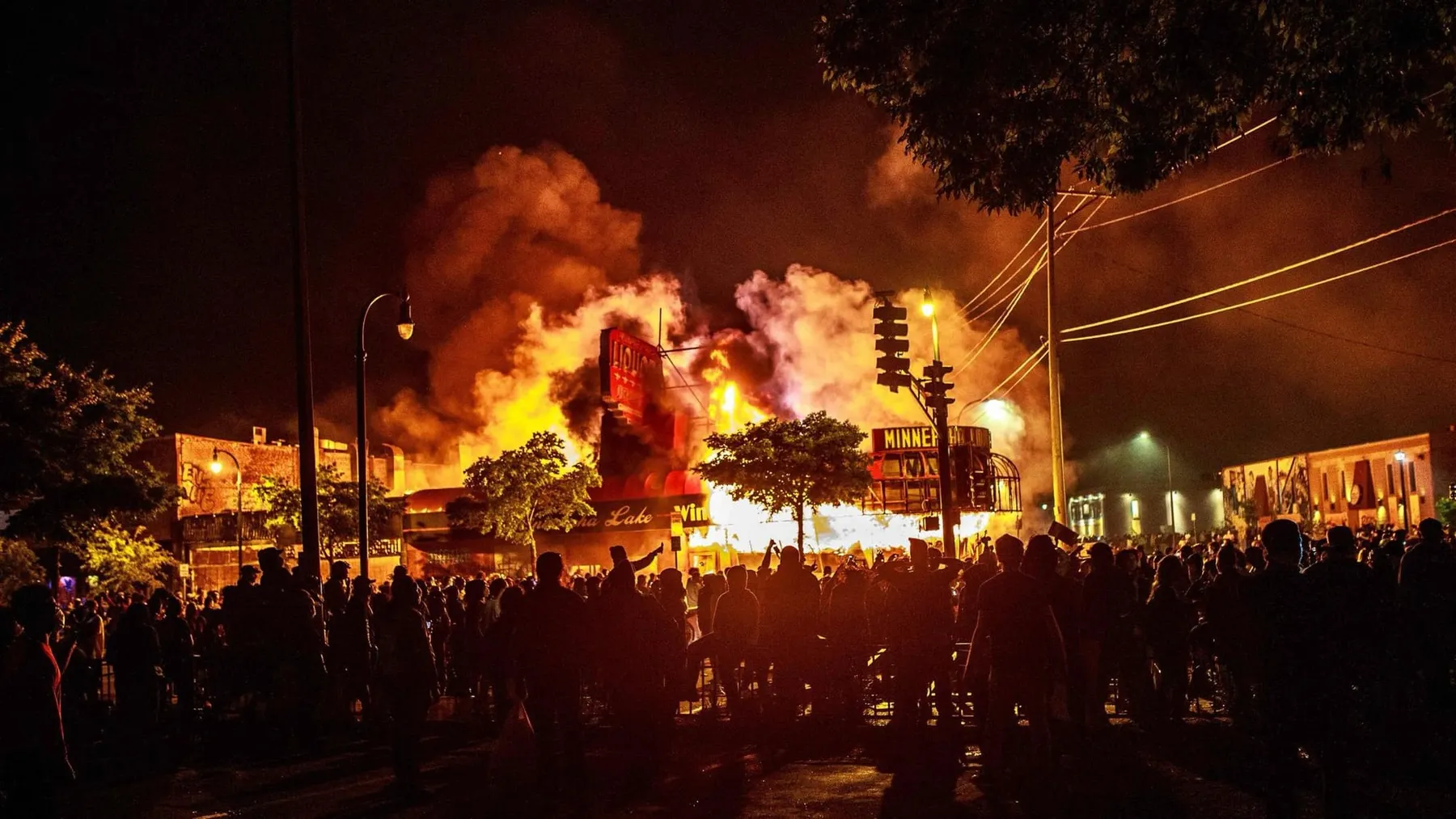
Six years ago today, the people of Minneapolis burned the 3rd Police Precinct to the ground to protest the murder of George Floyd. The killing of a Black person by the police remains an all-to-common occurrence in America. The uprising in Minneapolis, however, transformed this tragedy into a mass movement against state violence unparalleled in the past half-century of American history.
Despite the magnitude of events, institutional memory of the uprising has vanished, and the mainstream Left has already begun to retreat from abolitionism as an electoral liability. Since 2020, rates of police violence have only continued to rise, peaking in 2024 with 1382 people killed. This anniversary is more bitter than most because it also comes in the wake of the Supreme Court’s Louisiana vs Callais decision, which for all intents and purposes has put the 1965 Voting Rights Act out of its misery.
After the Civil Rights movement, racial integration undermined the power of the ruling class and created a democratic avenue for liberal reform, which made it incompatible with the Republican Party’s vision of an unfettered police state directed by the evangelical movement and large capital. The persistence of police murder and the victory of anti-Black voter suppression demonstrate both that the George Floyd Uprising and the legislative movement it spawned failed, and that the contradictions they aimed to solve remain a problem for socialist strategy. Capitalist rule depends on the authority of the police and the weight of the white vote. Defeating it requires retracing our steps to chart a positive program for abolition.
Poverty of Imagination
The Left’s failure during the uprising was twofold. Organizationally, we did not build new institutions that could effectively carry the politics of the movement into harsher conditions, and existing organizations like DSA failed to absorb militants activated by street protest. Politically, we were not able to move most participants from a reformist critique of police funding and behavior to a broader political movement against the police state. By the time the leaves turned, the most popular explosion of street militancy in our lifetimes had given way to the dementia of the Biden era.
It is easy to substitute alternate history for strategic thinking. Since 2020, leftists have spent thousands of hours arguing that more protests, stronger demands, or political education aimed at street militants would have resulted in one or another organization absorbing protesters in the millions. But there is no reason to believe that any change in tactics by the organized Left, which played a marginal role in the movement, would have altered the course of events. To actually position ourselves to make an impact during the next uprising, it would be more fruitful to approach the problem programmatically: what demands would the Left need to win to create a world where there is never another George Floyd or Tamir Rice or Breonna Taylor? What is the minimum program for Black freedom? How does this impact our political practice here and now?
Outside of the electoralist Left, the uprising and the burning of the 3rd Precinct became a popular justification for abstentionism. Why bother electing abolitionists or pushing for legislation when the masses were clearly ready to take things into their own hands? In practice, however, elections continued to be the central site where most Americans sought political leadership. This meant that thousands of revolutionaries, convinced that they could carry the movement through to the end via direct action, abandoned formal politics and let the liberals take center stage. The first lesson of the uprising is that political action is necessary to build a movement capable of actually seizing power.
For a brief period, the electoral Left engaged directly with policing. Even Alexandria Ocasio-Cortez called to defund the police, and collected signatures to support her position. As polling began to show lower and lower support for cutting police budgets, though, most politicians who had called to defund or openly identified as abolitionists reversed course, choosing to either remain silent or disavow their former positions. The emerging progressive common sense is to treat policing as a fringe issue worth sacrificing in exchange for institutional support.
In contrast, reformist abolitionism champions an argument for redistribution—that we should shift police funding toward social services in an attempt to cleave off broader working class support through bread and butter demands. Who doesn’t want more funding for schools? While the prevailing progressive logic argues that even redistribution is electoral self-sabotage, DSA candidates like Louisville’s JP Lyninger have taken office after campaigning openly on reallocation of funding.
As a candidate for mayor of New York City, Zohran Mamdani tried to balance both positions, promising reforms like disbanding the New York Police Department’s Strategic Response Group and eliminating its gang database, the formation of a Department of Community Safety for non-violent crisis response, and level services that would keep the NYPD officer count at 35,000. In practice, his tenure in office has mostly been defensive of the NYPD, its budget, and its political legitimacy. In Seattle, newly-coronated progressive mayor Katie Wilson, who sought and failed to receive DSA endorsement, has backed down on her campaign promise to remove police surveillance cameras from the city, bowing to the will of the Seattle Police Department.
While useful as a legislative tactic, the redistributionist argument erases the fundamental threat of police departments: their political power. Beyond acting as budgetary parasites, the police, their unions, and their lobby form a political bloc committed to reactionary politics; defending the right of the state to commit unchecked violence, supporting right-wing candidates, and colluding with other conservative institutions. Rather than merely a passive instrument serving local and state government, the police have a politics of their own, and organize on and off the job to implement it. Everywhere in the country, Blue Power is an obstacle to working-class political action and the liberation of the oppressed.
Black Liberation
The significance of the Black liberation movement has always been its emancipatory potential, not just for the Black working class, but for every dispossessed and disenfranchised element of American society. This pattern has repeated throughout history, from the slave revolts that made Emancipation possible, to the Black Populists that fought against the entry of finance capital into the post-Reconstruction South, and the Civil Rights and Black Power movements that defeated Jim Crow and defied the transformation of white supremacy into neocolonialism. Finishing Reconstruction would have meant destroying the planter class, whose capitalist descendants today form the resurgent base for fascism.
The Voting Rights Act undermined the political power of the white bourgeoisie and the evangelical movement by ensuring majority-Black constituencies could choose their own representatives. This provided a foundation for Black liberalism and a check on reactionary politics across the country, but had minimal impact on the economic dominance of the white elite, poor housing and employment conditions for urban Black populations in the North and West, and the subjugation of the Black working class in the South. Black mayors throughout the 1970s and 80s like Maynard Jackson and Tom Bradley attempted to reform the police through accountability measures and personnel changes, and by integrating more Black men into department leadership. But the culture and politics of police in Atlanta, Los Angeles and dozens of other cities where reformers held power has remained broadly unchanged.
Economically, the conditions for white supremacy have transformed dramatically over the past century, particularly in the South. The foundation of Jim Crow was the sharecropping system. Plantations tied Black farmers to the land, and superexploitation, debt bondage, peonage, lynching and segregation kept them in chains. Despite migration to the rest of the country, much of the Black population remains in the Black Belt, once the locus of Southern agriculture. The transition from an agricultural economy to low-wage service and light manufacturing eroded the economic conditions for apartheid, creating a modernized, low-wage and underemployed Black proletariat, either hired as “free labor” or enslaved in the prison system. But development did not erode the ideology of the Southern elite and the broader ruling class, which continues to be white supremacist and anti-democratic.
Black freedom remains anathema to the dominant factions of capital, producing a range of half-measures to maintain control—mass incarceration and felon disenfranchisement, police terror, denial of municipal home rule, gerrymandering, and attempted integration into the Republican voter base. Only time will tell if the ruling class coheres its methods into another formal system of apartheid or continues to oscillate from one form of brutality to another. Both paths lead to barbarism.
Responding to the scale and ambition of reactionary politics means reviving an old slogan: Black self-determination. Majority-Black communities live according to rules set by white-dominated state governments and judiciaries. Louisiana vs Callais deprived them of federal representation. In practice, they have no means of exercising power over their own lives, allowing xAI to dump formaldehyde into the air in Memphis and white lawmakers in Mississippi to encroach on the court system of Jackson. Without representation and independence from the aristocratic federal system, self-determination is impossible.
A minimum program to put the working class in power needs to address the central political questions of Black liberation. The old jurisdictions and districts need to be torn down and replaced by a system of proportional representation, allowing Black voters to choose their own representatives; the millions of prisoners rotting across the country need to be given the tools to self-organize and liberate themselves, including suffrage, freedom of speech and assembly, and the right to strike; the police need to be abolished, replacing the specialized, full-time force occupying working-class neighborhoods with mass organizations for public safety made up of and controlled by the working class; wealth (and, yes, police funding) needs to be redistributed toward reparations to Black communities, which suffer disproportionately from environmental devastation, lack of healthcare and decaying infrastructure. Finally, Black people must be given the right to land and secession, allowing them to determine their own path.
In short, for DSA to open the road to socialism, we need to incorporate the demands of Black liberation into our electoral platform. On the municipal level, this means directly challenging Blue Power and working to shrink the authority and power of the police, naming their role as an oppressive, occupying army terrorizing working class neighborhoods. On the federal level, it means fighting for radical democratization and reparations, creating the conditions for a politically powerful, organized Black working class.
The lesson of the George Floyd Uprising is not that street tactics are more significant than political action, or that abolition is not a viable electoral plank. It is that the democratic struggle of the Black working class is the lynchpin to the overthrow of capitalism. Black freedom lights the way to freedom for all of us.
Liked what you read? Subscribe to stay plugged in.