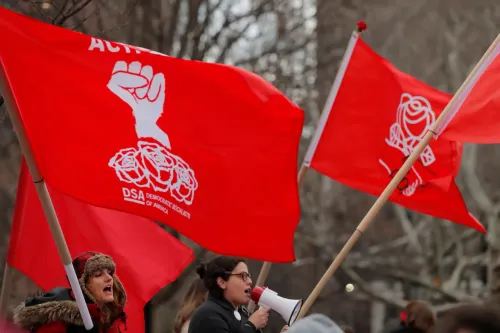



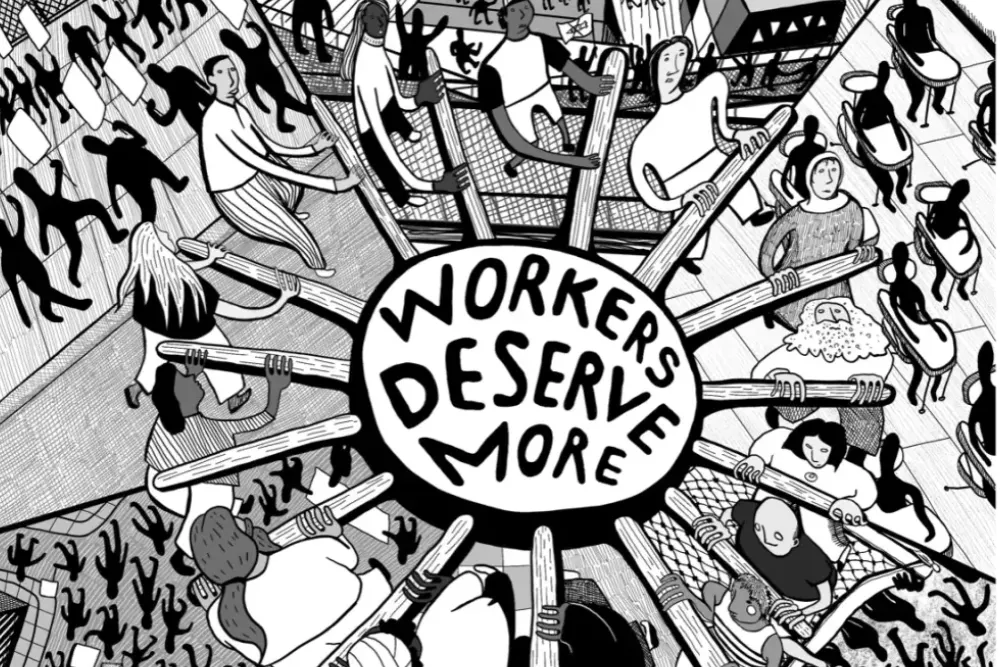
DSA’s return to national prominence has caused a frenzy on the far right. In the past few weeks, we have seen Fox News broadcast leaked demands from DSA’s new Workers Deserve More program and read from Marxist Unity Group’s points of unity. For the right, it feels like opening the basement door in search of an imaginary monster and discovering that all along, the monster was real—Socialists do want to see the downfall of everything you hold dear: voter suppression, AI art, paying for healthcare.
The media broadcasts its condemnations of democratic socialism by reading our own positions line by line, without any real persuasive argument or editorializing. For the right, it should be self-evident to the public that eliminating the Senate or defunding the Department of War is a threat to the American way of life. To much of the working class and the younger generations, however, Workers Deserve More is common sense. The hegemonic politics of the ruling class are collapsing.
Wilhelm Liebknecht, a radical parliamentarian in the Social Democratic Party of Germany, observed the same phenomenon in 1871, at the birth of socialist mass politics. DSA members have circulated screenshots of the title for his speech; Yes, We Want to Destroy What Our Enemies Call “Culture,” “Civilization” in response to the right’s panic. The article itself, one may be surprised, is a defense of universal public school and curriculum reform. For German conservatives, universal public education was an extremist attack on traditional national values. For the Social Democrats, it was a tool to create a new culture: one where everyone had the expertise to make industrial civilization their own. So is education a modest reform, or the end of a civilization?
The same question hangs over our heads. Is socialism really just about funding for libraries and schools? Is DSA fighting for a set of reasonable policies to maintain our existing public institutions? Or is it to transform social existence entirely? Can a single demand do both, or does the tension between the two eventually become untenable?
This dynamic can be intimate for socialists working in public schools. We clock in every morning and devote our labor power to our students’ lives; straining your voice to keep a classroom from spiraling out of control, kneeling on the floor to comfort a crying child, ducking out of the way when a student throws a chair, paying for school supplies out of pocket, staying for hours after class to lesson plan, working a second job just so you afford to keep being a teacher.
Then, leaving work exhausted. Saying goodbye to your coworkers as they return home to rest. Instead of going home, driving to a committee meeting, or a weeknight canvass, or a standout. Organizing for as many hours as you teach. Not just out of ideological fervor, but because if you don’t, every hour of labor you spent in the classroom will mean nothing. Capitalism will swallow your students’ lives the way it has swallowed billions of others before them.
Being an educator is a constant reminder of why you’re a socialist. You look at your students and see the world they are growing up into. You see ICE grabbing them from their families; the police throwing their belongings on the curb; their stomachs growling when a dry summer kills the wheat yield. Every day becomes a calculation for how much of yourself to put into teaching, and how much into struggle.
For Liebknecht, the revolutionary struggle is alive in every demand. If there is a tension between a reformist campaign and a revolutionary horizon, it was to be embraced and overcome. Yes, we want universal public school. Why? For the working class to develop the tools to bring capitalist society to an end. Schooling becomes contested territory between the new world and the old, and for socialists, there is no reason to compromise on how much funding to allocate or what model of instruction to practice. Knowledge must become common property.
The Russian Social Democrats also grappled with how to use reforms for revolutionary ends. In 1912, when the Russian labor movement was rebuilding itself and it seemed more and more possible that Tsarism could topple over on its own, the Petrograd Social Democrats made social insurance policy their core campaign. The state began to administer elections for a series of “kassy”—joint worker-management boards, organized at the factory level—to determine insurance policy. The Mensheviks responded by meticulously researching the ideal policy possible under the restrictive, centralized legal framework set up by the state, and campaigned for a winnable reform to benefit the working class. The Bolsheviks, refusing to recognize the legitimacy of the state, campaigned on uniting all of the factory kassy in a district into a single district-wide kassy, which would massively extend the leverage and organizing power of the workers. To the surprise of the Mensheviks, the unwinnable Bolshevik demand electrified the campaign and won over a majority of the workers' organizations.
Would social insurance of any kind have triggered a social revolution in Russia? No, not any more than Medicaid or workers’ compensation would imply revolutionary change in the contemporary United States. Accumulating economic reforms have always been compatible with capitalism. What made the demand for district-wide insurance committees revolutionary was the Bolsheviks’ refusal to accept the political legitimacy of the ruling class. It was a reform, yes, but one that openly denied that the Tsar or his government could freely dictate the terms.
In Imperial Germany, public school was a denial of bourgeois culture and its narratives about the working class. Opposing the formation of public schools meant denying that the working class could learn to think. Fighting for it relied on the logic that no one class of people was intrinsically more capable of wielding scientific knowledge and governing society than any other. Socialists should advocate for public schools, not as a politically neutral institution, but as a site of class struggle.
Workers Deserve More will pose the same problems for our own movement in the coming years. The ruling class will call it a threat to civilization. Our reformist comrades will call it a reasonable package of policy reform. We will be forced by the nature of our ultimate socialist and democratic aims to bring the program through to its revolutionary conclusion; to prove the reactionary wing of the ruling class right.
Wilhelm Liebknecht, Yes, We Want to Destroy What Our Enemies Call “Culture,” “Civilization,” October 1871.
Written as a speech in German, delivered to supporters in Chemnitz, Saxony, October 22nd, 1871:
[ . . . ]
In a few sentences, I want to quickly address the first accusation that I am faced with—that we are the “barbarians of the nineteenth century,” that we want to “destroy our culture,” and that the victory of Social Democracy equals the “downfall of civilization.”
A party that aims to make universal education free for the people and that wants in general to make all educational institutions free cannot feel that this accusation applies to it. However, in a certain respect, we must plead guilty as charged.
Yes, we want to destroy what our opponents call “culture” and “civilization.” We want to destroy servitude and oppression, we want to destroy the seeds of hatred and discord sown among men, we want to destroy the ignorance, the spiritual night into which the vast majority of our brothers have fallen. Yes, gentlemen of the bourgeoisie, we want to destroy ignorance, we enemies of your culture! Your culture is precisely the opposite of culture: it can save itself only by condemning the people to stupidity, by brazenly withholding from them the treasures of true culture, by closing the temple of education to them. To open this temple to the people, that is our endeavor: science, which you make the monopoly of a chosen few, and for which you will not spare a crumb of bread if it does not flatter your whims, indulge your self-interest—we want to make science the common property of all.
And this is to be done by a system of genuine elementary schools—not rote learning as is the rule at public schools today, which make a mockery of the name; not elementary schools whose teachers are starved physically and whose pupils are starved spiritually, and which throw to the children of the poor a few meager crumbs which are not even remotely sufficient to nourish the spirit—not elementary schools in which the lowest measure of knowledge is taught—no, elementary schools in the true meaning of the word, schools for the people, which impart to all children the highest possible measure of education, which awaken and develop in each child all the aptitudes, and do not, as today, stop at an age where real education only begins. Socialism: “hostile to culture”! Because it allows every talent the possibility to develop? A tremendous lever of cultural progress lies in this mere fact of real popular education!
Talents are evenly distributed among people—this is a truth that science has raised above all doubt, and to which we must adhere because it forms the basis of the socialist and democratic worldview; but today’s society allows only the fewest to develop their gifts, and even to these few, with rare exceptions, gives only a one-sided, crippled education. The vast majority of talents are now completely stifled.
One often wonders why in certain epochs so many important men are made. These are precisely epochs in which slumbering talents are given the opportunity to express themselves and to be active; this is especially the case in revolutionary epochs, which call for new forces to defend new ideas and institutions. Take, for example, the mass of great statesmen, orators and generals who characterized the French Revolution. In such times there is no more talent than in ordinary times, but—to use an economic expression—there is more demand for talent.
Opportunity not only makes thieves, it also makes “great men.”
A “great man” is an ordinary man who has had the opportunity to become “great.” This is only to show how infinitely our culture must be improved if society would one day consider it its highest task to bring the talents of all to the highest possible development. In other words, the highest possible level of education for all!
We want to make science accessible and free to all; it should no longer be shackled, its service no longer condemned to material poverty or intellectual prostitution. Yes, we want to destroy your culture—we want to destroy it because it is hostile to true culture; because it is incompatible with true civilization; because it forces science to sell itself to wealth and power; because, based on injustice, it is thoroughly immoral.[1]
Light & Air has lightly abridged the full text out of disagreement with a metaphor used by Liebknecht. The political meaning of the text remains intact, and the unabridged document can be read on the Marxist Internet Archive. ↩︎
Liked what you read? Subscribe to stay plugged in.